
1976 Retrospective: Dying in Darkness; The Mythmaking of "All the President’s Men" at 50
Author’s note: This is the first in a series of retrospective essays diving into the films of 1976, their importance to the canon, and how they reflect the world then and now.
We do not live in 1976 anymore.
This is an obvious, albeit necessary, observation. 1976 was half a century ago, and it took place on an entirely different version of Earth. The United States had yet to elect a television star president, Mao Zedong still ruled in China, Vladimir Putin was just beginning a training course on surveillance and counterintelligence for the U.S.S.R. Phones were connected to walls. The internet didn’t exist. Artificial intelligence was pure science fiction. For Americans, the cost of housing has increased 558%, the cost of healthcare, 1038%. People, all over the world, make less and spend more. They have more neighbors and less interaction. Over their heads, carbon dioxide is concentrating in the atmosphere nearly four times faster annually than it did fifty years ago. But at the time, almost nobody knew. They got their information daily, not instantly, in words written by experienced journalists, printed every morning and evening on paper.
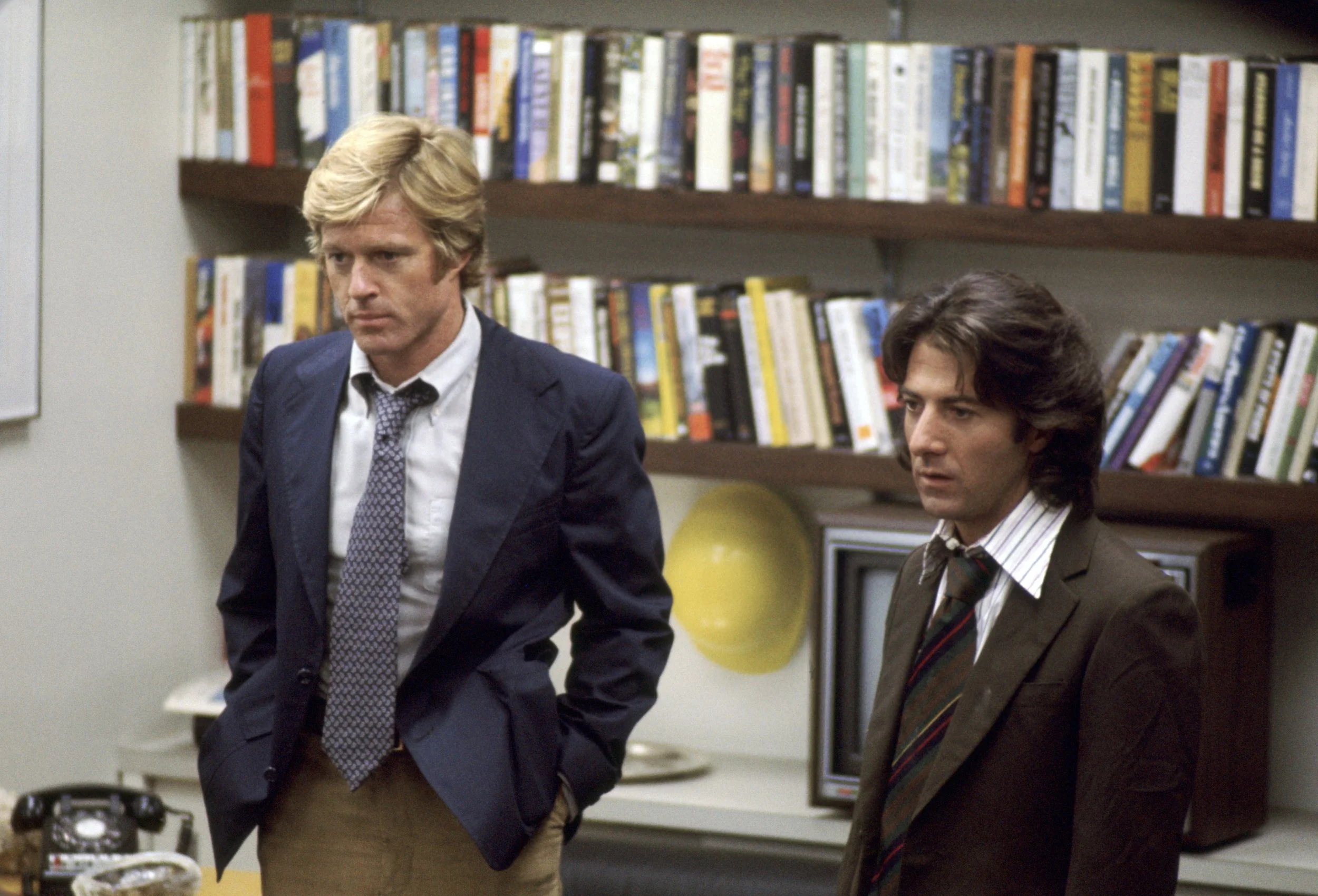
Those newspapers are where millions first heard the name Watergate. They are where millions followed the unraveling of President Richard Nixon’s second term. They are where, in 1976, millions of theatergoers checked to find showtimes for the dramatized, soon to be immortalized, version of these events: All the President’s Men, which in turn immortalized those very newspapers and the specific world they represented.
By the time of its release, All the President’s Men was a familiar story. There were few in the United States who wouldn’t recognize the names Bob Woodward and Carl Bernstein, and fewer still who wouldn’t recognize their work. The two Washington Post reporters were the principal architects of the journalistic uncovering of the Watergate break-in that ultimately led to President Nixon’s resignation. (They were not the sole reporters focused on the scandal, however, as All the President’s Men would lead you to believe.) Their stardom and accomplishments were well established by the time Robert Redford and Dustin Hoffman — two of the biggest actors on the planet — took up their likeness.
All the President’s Men, which was released fifty years ago this week, was an instant classic, in the truest sense of the word. The brainchild of Redford, screenwriter William Goldman, and director Alan J. Pakula, the film received unanimous critical acclaim, grossed over $400 million adjusted for inflation, and left the 49th Academy Awards tied for the most wins. Thirty-four years after director of photography and “Prince of Darkness” Gordon Willis hung a camera from its ceiling, All the President’s Men was preserved in the Library of Congress. It was, of course, destined to be a movie receiving retrospectives half a century after its release.
There is much to be made in these retrospectives about the eternal charisma of Robert Redford (I believe in it), the power of journalism to check rampant political corruption (I have my doubts), and the undeniable inspiration All the President’s Men had on generations of soon-to-be journalists (I, like many others, pursued the dying newsroom because of it). However, it’s difficult to watch All the President’s Men and not be struck, most immediately, by how alien the world of 1970s Washington D.C. is to us today.
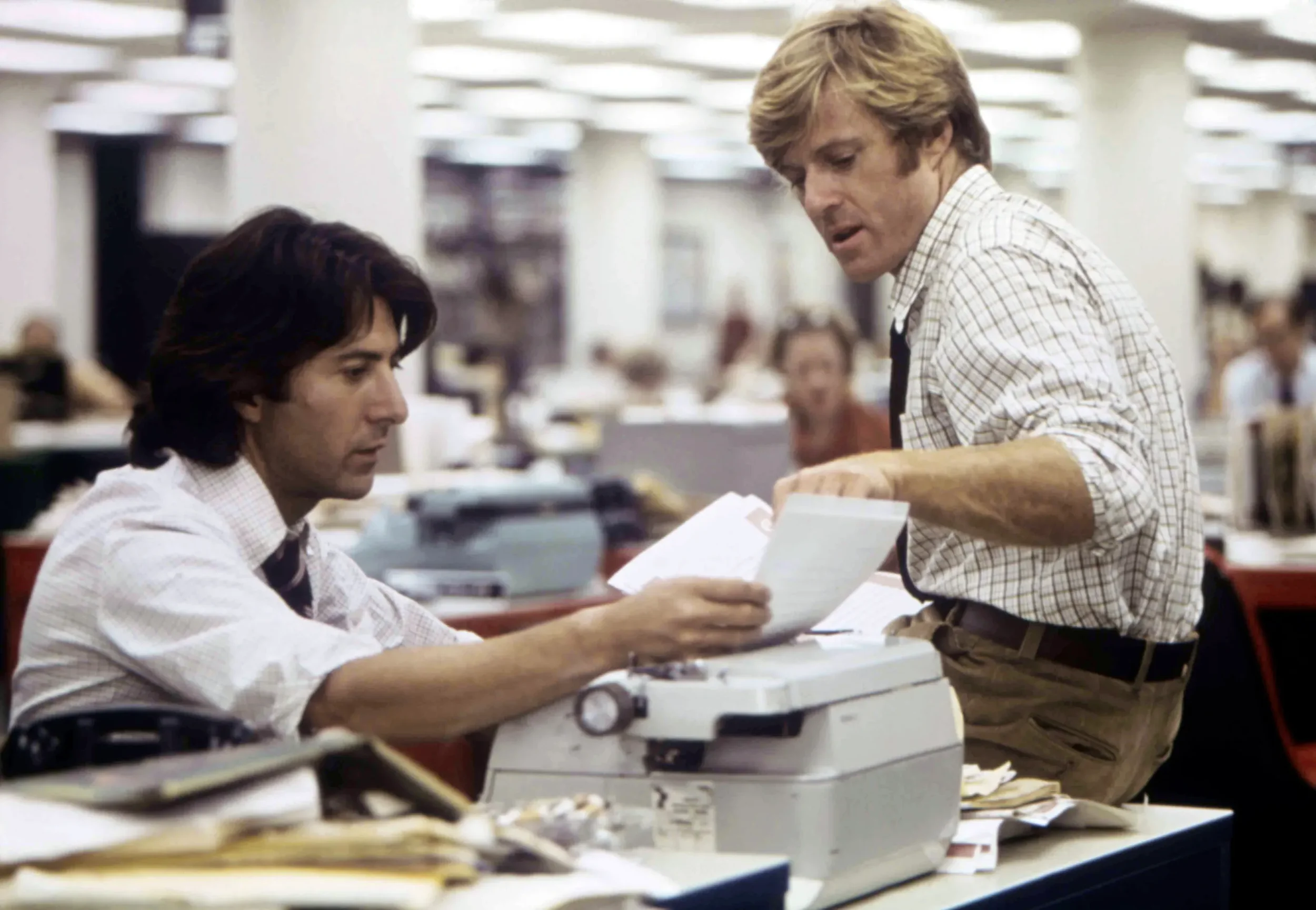
It is a world of analog paranoia, where the boogeyman doesn’t watch from behind a screen but rather from the shadows surrounding a parking garage. It is a world where Dustin Hoffman could knock on a door, ask for a cigarette and a match (which one would have), and proceed to uncover buried government secrets. It is a cacophonous world, filled with the sounds of typewriters and phones ringing, two items that are so sonically out of vogue they would get you reprimanded in any contemporary newsroom. The set, sound, and costume design deployed by Pakula’s team is extraordinary in this sense. They not only replicated The Washington Post’s newsroom, they captured every granular characteristic of the mid-seventies impeccably. That may seem easy today — because the seventies were fifty years ago and we recreate the era often in film and television — but the actual act of capturing the moment while still in the moment is a tricky endeavor. It must be unmistakably accurate to the present and legible to the future.
Pakula himself is no stranger to the contemporary political thriller, hence why he was tapped to dramatize the most important news story of the 20th century. All the President’s Men served as the finale in Pakula’s unofficial “Paranoia Trilogy,” following 1971’s Klute and ’74’s The Parallax View. Though only connected by theme, these films embody the ethos of the era: gritty, grounded skepticism in powerful American institutions. Pakula understood (and repeatedly reinforced) the notion that a conspiracy isn’t a conspiracy if everybody believes it. And in the 1970s, everybody believed the government was lying to them.
Compare that with today, where everybody chooses who they believe isn’t lying. Conspiracy is dead. The general populace can’t even agree on what the baseline information is, let alone conspiratorial hedges. But the world of journalism in 1976 was not a world of “misinformation.” Nor was it treated as such. People trusted the press more than they did the government. Walter Cronkite was the most trusted man in America. Pakula’s films weren’t seen as politically charged. They espoused universal and wholly reasonable skepticism. If anything, All the President’s Men can be faulted for being too optimistic.
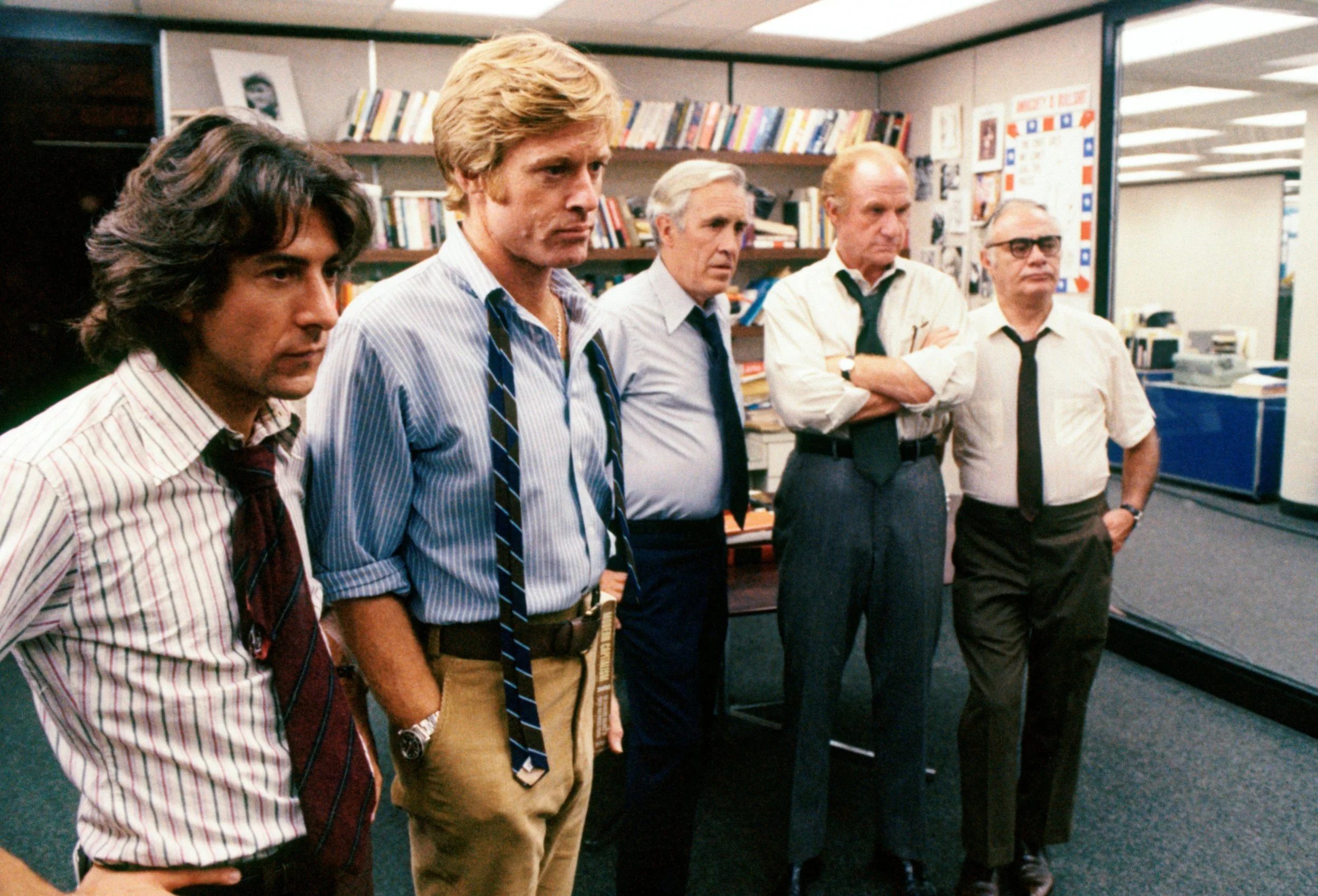
As Woodward and Bernstein barrel towards a now famous conclusion — that orders to break into the Democratic National Committee’s headquarters had come down from the Oval Office — managing editor of The Washington Post, Ben Bradlee, counsels them, “Nothing's riding on this except the, uh, First Amendment to the Constitution, freedom of the press, and maybe the future of the country. Not that any of that matters…” It’s tongue-in-cheek from Bradlee, who’s played to perfection by Jason Robards, but it’s also tacitly optimistic. We know today, as audiences did in 1976, that the “good guys” won here. “Woodstein,” as Bradlee chides them at one point, won The Washington Post a Pulitzer Prize for Public Service. Deep Throat, their infamous source at the F.B.I., was protected. President Nixon resigned. But did they save the First Amendment? The freedom of the press? The country?
In 1976, most general audiences said, “Yes.” That’s why those are the last lines of the film. Entering the final scene, they hang in our mind as we watch Woodward and Bernstein typing away furiously at the pages that would eventually undo Richard Nixon, whose second inauguration plays triumphantly in the foreground. Knowing what we know now, the ending is little more than wishful thinking. And wishful thinking is always temporary.
By the mid-2020s, the America that Woodward and Bernstein had worn through their shoes to save no longer existed. It hadn’t for a while.
Then again, maybe it never had. Because, while All the President’s Men ends with a bit of wishful thinking, it is mostly — almost entirely — an act of mythmaking. Two heroes, taken seriously by none, undaunted by what lurks in the shadows, aided by a real life deus ex machina, took on the ultimate Big Bad… and won. It is a myth spun so perfectly, so beautifully, one could not help but be swept up by it. Is that how it really happened? It doesn’t matter. All the President’s Men gave us a myth to believe in.
Fifty years later, in a different world, there’s only question left burning: Do you still believe it?