
Movie Review: "How to Make a Killing"; A Predictable and Digestible “Thriller”

6/12 ForReel Score | 2.5/5 Stars
Glen Powell can’t lose. His jet isn’t shot down. His hitman isn’t caught. No twister or Australian predator can stop him from getting the girl. The smile cannot be wiped. The dimples are eternally Botoxed into place. Powell isn’t just a Hollywood leading man, or even a protagonist. He is a winner. Even when he loses, he still wins. This is both the crux of Powell’s new film, How to Make a Killing, and the underlying shortcoming of his theatrical toolbox.
A modern American adaptation of Kind Hearts and Coronets, How to Make a Killing tells a story all too familiar, even if you haven’t seen the 1949 British film it’s loosely based on. Disowned by her billionaire Long Island family, Mary Redfellow (Nell Williams) is forced into “middle class” while raising a son alone. Following her untimely death during her son Becket's childhood, he is thrown into the foster care system, before eventually growing into a well-adjusted and successful middle class adult. But this adult Becket (Powell) wants for more. He wants for the family inheritance that he will eventually get but that he feels is owed sooner. So, he undertakes a mission to eliminate the seven family members standing between himself and billions.

Image courtesy of A24
Convoluted? Yes. Original? Not so much. This is a story told, in some way, as recently as Saltburn and as far back as Shakespeare. But unlike its predecessors, the “why” of Becket’s mission is secondary to the “how.” The “why” is some combination of mid-life crisis, a tortuous connection to his childhood love Julia (Margaret Qualley), and despair for his long passed mother. It’s a flimsy work of writing from writer-director John Patton Ford, but again, the screenplay is more interested in the “how” of it all. (The film’s title comes as no surprise once you see where Ford takes his time in the picture.) And, for all its worth, how Becket eliminates his family members plays as a romp.
The kills are entertaining, if not blindingly silly — with an acute blindness to glaring plot holes. The family members are played by a supporting cast (Raff Law, Zach Woods, Bill Camp, Topher Grace, and Ed Harris, among others) having a delectable time in inevitable roles. The film excels when its characters have a clear goal (for the supporting family: die), and it falters when they don’t. This is especially true for Margaret Qualley’s Julia — who pops up for the first half of the film only to remind us she exists, before suddenly becoming the focal point of the plot — and Jessica Henwick’s Ruth — a girlfriend with too much screentime for too little to do. There is, of course, also Becket Redfellow: a man whose goal makes the movie. Except, we don’t care if he reaches his goal. Because we know he doesn’t.
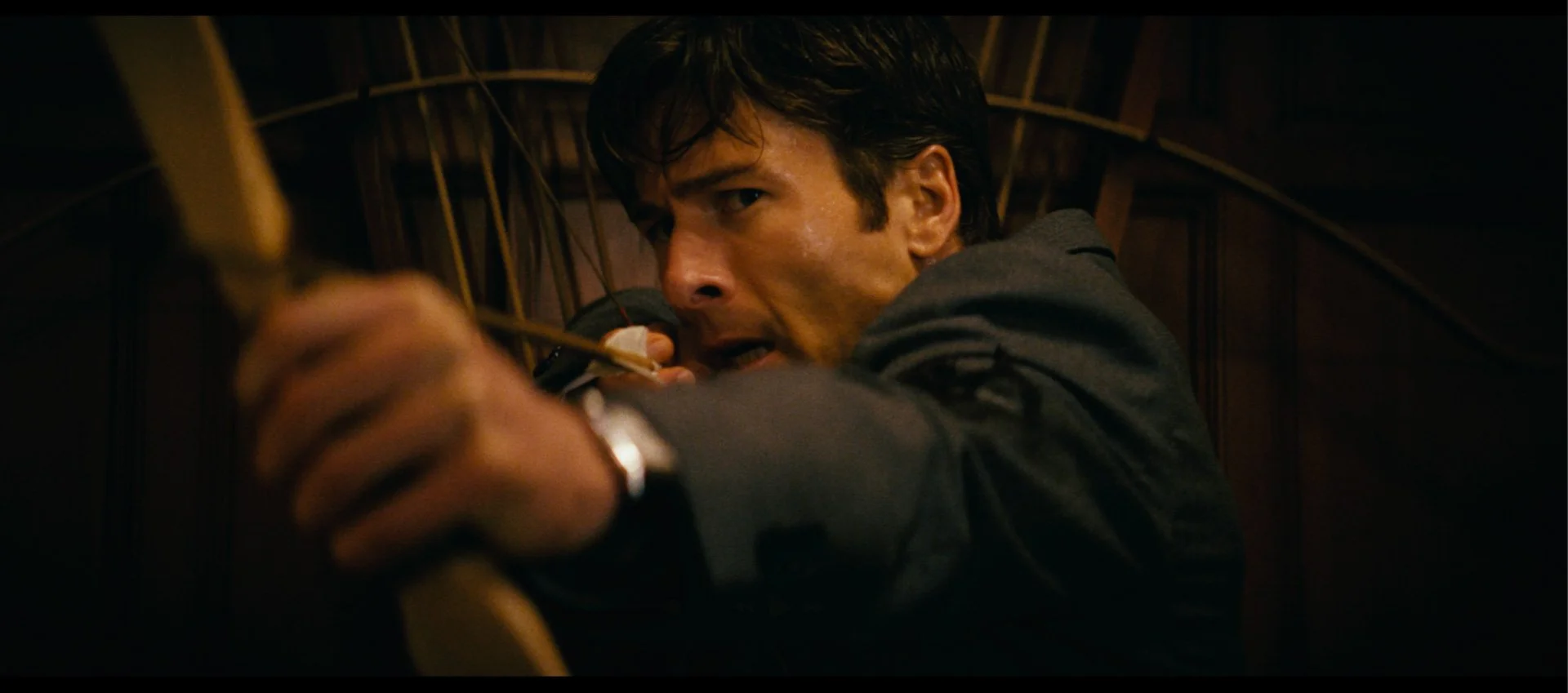
Image courtesy of A24
The opening frames of How to Make a Killing is its crucial failure: Becket, on death row, is narrating his accomplished familicide to a priest, mere hours before his demise. This eliminates the “will he?”/”can he?” question, leaving only the “how.” But as the answer to how Becket will kill his family begins to slowly reveal itself, a more pressing “how” begins to emerge: How will Becket get out of this? Because we know he will. Because Becket is played by Glen Powell, and Glen Powell cannot lose.
To say here how the film resolves itself would be both a spoiler and wholly unnecessary. You either know or you can guess. The answer isn’t as interesting as the question, and the question never carried weight to begin with. It’s merely procedural. Glen Powell will get away. The steps may be long and overly complicated, but it will happen. That’s the rule. It’s why How to Make a Killing is titled like an instruction manual and not a question.
Acting and Casting - 2 | Visual Effects and Editing - 1 | Story and Message - 1 | Entertainment Value - 1 | Music Score and Soundtrack - 1 | Reviewer’s Preference - 0 | What does this mean?