
Movie Review: "Project Hail Mary" Is A Triumph As Unlikely As The Mission Itself

12/12 ForReel Score | 5/5 Stars
Carl Sagan once said, “The Cosmos is within us. We are made of star-stuff. We are a way for the Universe to know itself.” We look to the stars in search of understanding the universe and our place within it, which is why space-travel science fiction is such a compelling sandbox to play in. From high-concept films like Interstellar and 2001: A Space Odyssey to quietly introspective ones like Solaris and Ad Astra, the vastness of our universe is a vessel for looking inward, contrasting our smallness with the immensity of the great beyond. Such is the crux of director-duo Phil Lord and Chris Miller’s latest, Project Hail Mary. Adapted from Andy Weir’s novel of the same name, Project Hail Mary is nothing short of a masterwork in sci-fi filmmaking.
After waking up from a medically induced coma, amnesiac Ryland Grace (Ryan Gosling) is the sole survivor of the Hail Mary, a vessel hurtling towards the Milky Way in a last-ditch effort to save the world. Not only is Grace tasked with the mission, but he also has to remember why he's on it. Similar to the last Andy Weir adaptation, Ridley Scott’s The Martian, Grace’s real-time problem-solving is as thrilling as it is amusing, as Gosling does a one-man show blend of his work on The Nice Guys and First Man. However, calling Project Hail Mary a “one-man show” is both accurate and reductive. Accompanying Grace is Rocky, the sole survivor of his respective ship. A faceless, five-legged, chime-speaking alien puppeteered and voiced by James Ortiz, Rocky is far and away the MVP of Project Hail Mary.

Image courtesy of MGM Studios
Even in the Jump Street duology (is it too late for 23 Jump Street?), Lord and Miller’s films are all about connection through unlikely circumstances. The opposites-attract charm of Jump Street, The Lego Movie, and Cloudy with a Chance of Meatballs, combined with the multiversal boundaries of Spider-Verse, makes Project Hail Mary feel like the logical conclusion to the past twenty years of Lord and Miller’s creative partnership. Project Hail Mary hinges on Grace and Rocky’s friendship, both of whom share the same goal of saving their respective planets. Beyond solving a multi-apocalyptic crisis, the two also have to learn to understand each other, verbally and emotionally, creating an ironclad “me and bro” bond that I could've sat with for hours.
When I wasn't flipping through pages like a maniac, most of my read-through of Project Hail Mary consisted of me wondering, “How the hell are Lord and Miller going to pull this off?” Now that they've done it, I still don’t know how they did it. Between Miller declaring that production used no green and blue screens, the blend of practical puppetry and animation for Rocky, and the immense production design, Project Hail Mary is the type of blockbuster that raises your standards for filmmaking tenfold. I’m not one to talk numbers, but there’s no reason that a movie at this scale (reportedly $150,000,000) should cost less than half of the most recent Ant-Man. It’s a stunning achievement through sheer form and craft; although Project Hail Mary is much more than its bells and whistles.

Image courtesy of MGM Studios
That said, Project Hail Mary’s bells are shiny as hell, and the whistles sound amazing. Lord and Miller, alongside Dune cinematographer Greig Fraser and Spider-Verse composer Daniel Pemberton, have concocted an audiovisual spectacle for the ages. I usually dislike it when critics say “see it on the biggest screen you can,” except I’m not saying it—I’m demanding it. Having Project Hail Mary tower over you (in a 1.43:1 aspect ratio, for all my nerds out there) on an enormous IMAX screen with Pemberton’s score barraging your eardrums is an experience only rivaled by the likes of Interstellar, Dune, and approximately ten minutes of Fantastic Four: First Steps. Reading Weir’s vivid imagery is one thing; seeing it fully realized on an eighty-foot screen is another.
The magic of Project Hail Mary is not only the foundation laid by Weir, but also how screenwriter Drew Goddard adapts Weir’s material. Having also penned The Martian for Ridley Scott, Goddard pairs with Weir like peanut butter and jelly, sanding off my qualms with Weir’s writing (Weir is allergic to any swear word beyond “crap”) to great effect. Goddard, along with Lord and Miller, does an excellent job visualizing and condensing Project Hail Mary’s hard sci-fi concepts into digestible, jargon-less dialogue that maintains a sharp, naturalistic pace. Goddard (mostly) skirts the similar “captain’s log” style of narration from The Martian, primarily because Grace has someone else to talk to, with their banter and shared goal making for great company throughout the film’s two-and-a-half-hour runtime.
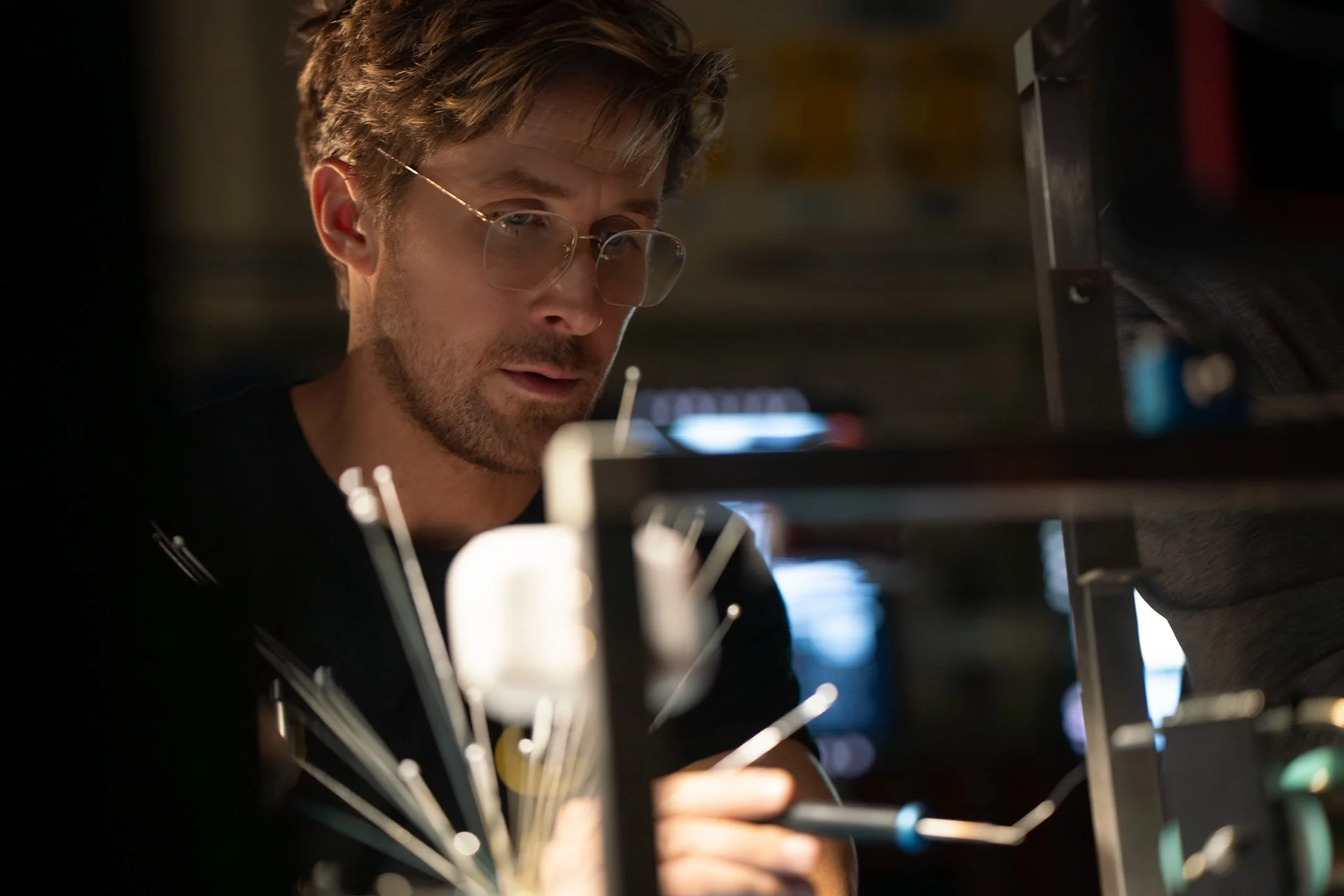
Image courtesy of MGM Studios
Like The Martian, Project Hail Mary’s hook—outside of the core mystery—is the focus on survivalism. Whereas The Martian was more of an exercise in pulling yourself up by your bootstraps, Project Hail Mary is about how much survival depends on one another. While Ryland and Rocky are in space, an international coalition of scientists (run by a steely Sandra Hüller) comes together to solve the problem at home, a throughline that feels direly needed given current events—environmentally and geopolitically. A piece of me wishes the film delved as deeply into these topics as the book does, though that probably would've added another hour to an already humongous runtime (extended cut, por favor?). Exchanging some of the novel’s nitty-gritty procedural aspects for a tighter, more emotional narrative is an easy trade to make, especially when the end product is this good.
It’s been days since I’ve seen Project Hail Mary, and I’m still wrapping my head around how this movie exists and what we did to deserve it. Those expecting a 1:1 adaptation will, as always, be a bit let down by the slight truncation of Weir’s epic novel, although the broad strokes remain fully intact. Not only is it Ryan Gosling’s best work since, coincidentally, First Man, but it’s also a new high point for Lord and Miller thus far. It’s the only work of interplanetary sci-fi in the last five years that holds a candle to that of the Dune duology (soon to be trilogy, if all goes according to plan) or Avatar: The Way of Water. It may be too early to deem Project Hail Mary a classic, but I’m certain that Ryland Grace and Rocky will go down as a dynamic duo for the ages.