
Movie Review: "You Can See Everything"; A Subversive Nathan Fielder Experience You Have To Witness For Yourself
Editor’s Note: You Can See Everything is what I would describe as an extraordinary, unparalleled theatrical experience. The following review expertly avoids most of the film’s major spoilers, however to fully appreciate the impact of this particular film, I encourage audiences to unpack the narrative intricacies firsthand before engaging with the interpretations of others.
Trust me. This review will serve you better after you’ve seen everything.
- Thomas Stoneham-Judge, Editor-In-Chief

12/12 ForReel Score | 5/5 Stars
Where can I even begin to talk about You Can See Everything? This immediate confoundedness seems to be a natural reaction to the ever-audacious work of Nathan Fielder, and as of more recently, Lance Oppenheim. Fielder in particular has developed a signature brand of dry, deadpan delivery mixed with an unparalleled skill in using the trappings of documentary form to mine what I can best describe as ‘absurdist realism’. From the beginning of his time as a multihyphenate, he has extensively played with the audience’s perception of reality, most prolifically through a series of meticulously produced, real life ‘simulations’ and recreations in his HBO series, The Rehearsal, widely lauded as one of the medium’s most audacious projects. Through all of his work, Nathan is a complete enigma. Despite spending so much time with him, and hearing his voice and his methodologies, his sheer persona has remained so enigmatic, and you can truly never guess what he’s going to do next.
This enigmatic aura similarly enveloped You Can See Everything, Fielder’s long rumoured ‘secret project,’ shot with co-director Lance Oppenheim (Primetime) over the span of a few years, remained so elusive that its existence was not properly announced until a mere few weeks prior to this review, where a ‘secret A24 film’ was set to debut at the Telluride Film Festival, with audiences literally going in blind to what can only be described as one of the most formally daring films of the century.

Image courtesy of A24
The film follows Fielder and Oppenheim creating a documentary centered around disgraced biotech founder, Elizabeth Holmes, whose spearheading of the now-dissolved company known as Theranos, and its subsequent fraudulent activity made Holmes the center of extensive media attention and scrutiny. Said media coverage spawned several news reports, exposees, and podcasts, the latter of which inspired a dramatized Hulu miniseries called The Dropout, which went on to be immensely popular and garnered its lead actress Amanda Seyfried an Emmy nomination.
You may have noticed that this review contains a large amount of expositional text thus far, and I assure you, this is for good reason, but be warned, however much you think you might know about Holmes’ legal situation or Fielder’s style cannot prepare you for the sheer magnitude of You Can See Everything. At the behest of Fielder and Oppenheim via a pre-recorded video message for press screening the film in advance, some major beats and transpirations in You Can See Everything will be very vaguely alluded to or skirted around entirely. This Marvel-level secrecy for a film, that on paper, seems to be a documentary following a real figure whose life has been incredibly public, may seem over-the-top, and I assure you that it is anything but. Let me simply say, I think we’ve finally seen cracks in the enigma that is Nathan Fielder, or at the very least, he’s met his match.
Fielder and Oppenheim were invited to live with Holmes, her husband / fellow venture capital personality Billy Evans and their children in a San Diego rental home, in the months leading up to Holmes’ prison sentence. Our two directors try to examine the psyche of Holmes, whose nature becomes even more elusive up close. Holmes’ serious financial crimes are extensively documented, and yet she still denies any wrongdoing at any turn. Due to the intimacy of the staging, there are points where even those with the most preconceived notions and knowledge of Holmes will feel disarmed by how continually aloof she comes off as. From the marketing alone, (see the trailer and poster for example), there’s such an eeriness to Holmes’ smile and bulging blue eyes, each containing so much morbid intrigue. Then again, we return to the heart of Nathan and Lance’s exercise, what is real when it comes to Elizabeth Holmes. Is she somehow someone whose aspirations were hijacked beyond her control and twisted into some large scheme, or someone whose nature is even more cunning and sinister than the Theranos scandals. Though Oppenheim's choices of intense facial close-ups in the 4:3 aspect ratio certainly invoke a more avant-garde sensibility throughout the first half, some might still say that this half, with footage prior to Elizabeth’s incarceration, amounts to a relative softball by Fielder’s standards, and does spend time trying to be more conventional and in doing so, does expose the emotions that Holmes feels in having to leave her children behind during her prison sentence, and how she still feels unjustly scrutinized for a situation she claims she is innocent in.
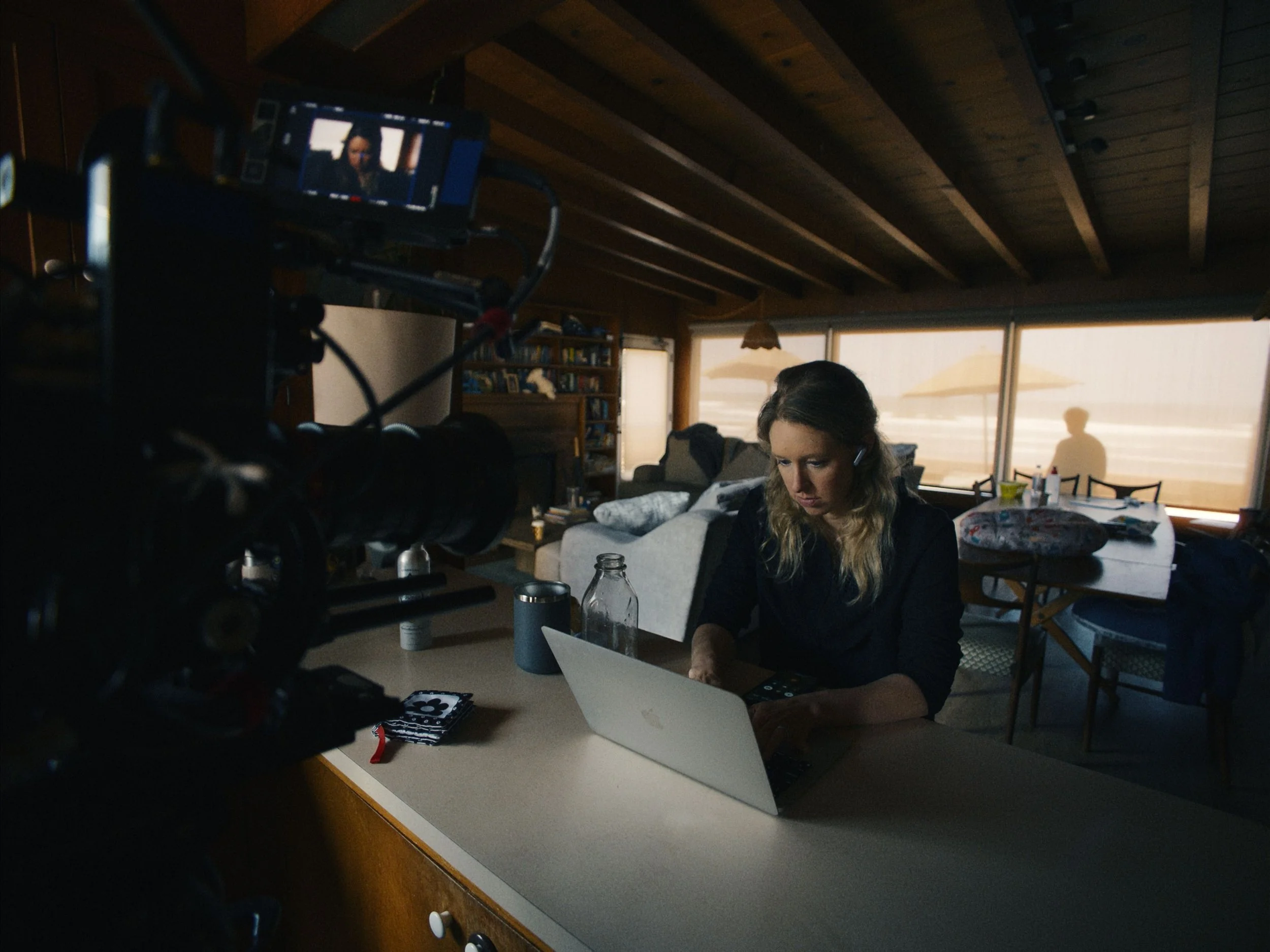
Image courtesy of A24
The questions persist. Is Holmes truly who she says she is, an innocent, well-meaning woman unknowingly embroiled in one of the biggest scandals of our time? At this point in the film, it certainly wouldn’t be crazy to think that maybe she is telling the truth, thanks to the incredibly impactful emotional focalization.
However, what remains more impactful is just how subversive the film ends up becoming, both of its own accord, and somehow more perplexingly. I am of the belief that great meta-filmmaking involves the creatives understanding their own biases, and making them known to the audience with a certain conviction. Here, that conviction is blunt, and even implicitory. Nathan’s attachment to Holmes intentionally goes beyond the idea of her as a proverbial case to crack, and this is called out by others directly involved in the documentary/investigation process. Much online discourse sprawled from the ethical debates of how Fielder depicted the lives of real people and their presumed obliviousness to Nathan’s whole ‘schtick’ with The Rehearsal, and though it is comparing apples to oranges, You Can See Everything feels as if it has its bases covered, to the fullest extent that it can, at least. Fielder and other major creative participants are shown actively weighing the moral, legal, and financial ramifications of so many things they do during the production of the documentary, and because of the sheer absurdity of the further conspiracies they come across, this somehow adds stakes to a film rooted in real, public circumstance, instead of self-aggrandizing posterity.
The comparatively lighter, more intimate first half is ultimately upended by two major developments. One of these developments is of Nathan’s doing, bringing in a prolific new collaborator who delivers an incredibly daring turn in terms of dramatic and real-life feats, changing the entire scope of the film, propulsively thrusting us beyond avant-garde territory, while still grounding the whole thing, as a kind of anchor who offsets Nathan and Lance’s more cryptic tendencies. Their mere inclusion could have felt like unbridled spectacle or a mere shock-value inclusion that would torpedo any interrogative capital the film built up, but instead unlocks a truly stratospheric quality to an already unbelievable piece. It pains me to have to sing this collaborator’s praises so extensively while still skirting around their identity, but I already feel as if I’ve said so much.
The second major development arrives with so much unintentional gravitas that it almost feels like a series of meticulously planned plot twists have unraveled, opening a whole other movie, one that unlocks a new gear of interrogation, pertaining to the ever-relevant corrupting powers of society.
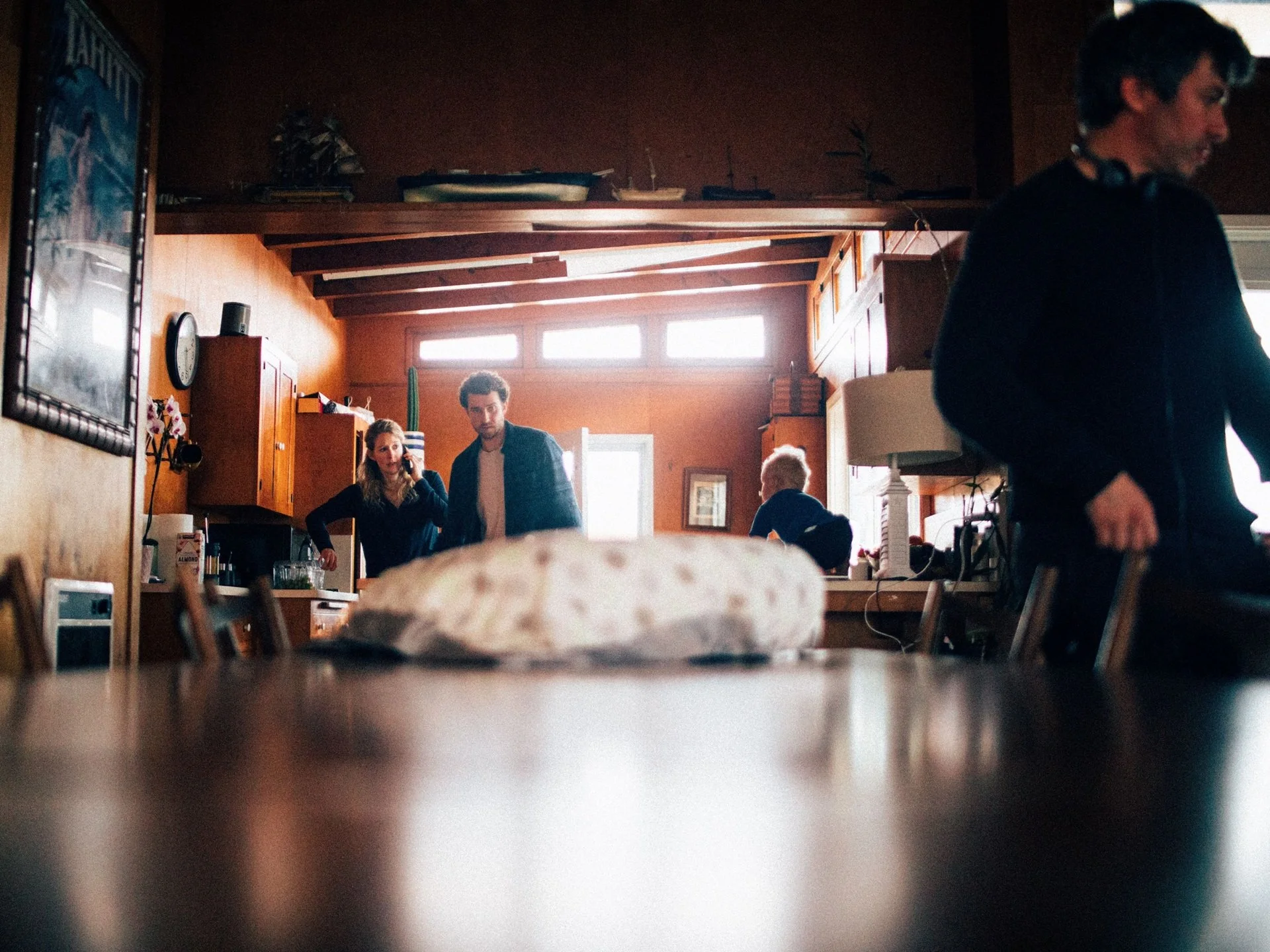
Image courtesy of A24
Each of these developments transform the structure of the film in such a way that I can’t even begin to classify. The intimate look at Holmes and her family is slightly interrogative, but when the film straight-up becomes an investigative exercise by way of performance art and our directors’ formal wizardry, which uses a semi-conventional editing rhythm to guide us along the unique journey, strung together by the perfectly punctuative score by Ari Balouzian.
Perhaps this is not the most relevant takeaway, and I don’t mean to discredit the incredible part played by Lance Oppenheim in assembling this behemoth of a motion picture experience, but You Can See Everything truly feels like an evolution on Nathan Fielder’s part. Many have tried (and failed) to distinguish between what’s just an elaborate comedy bit / social experiment with Nathan, and when he’s genuinely trying to go for sincere pathos. I personally feel that in a truly strange twist of fate, so to speak, (which is largely informed by the sheer absurdity inherent in the subject matter unfolding in real time), this film lets us see Fielder at his most off-guard, all things considered. Though still giving us many classic laughs, Nathan is straight-up out of his element, even as the film features his most shocking and ostensibly most effective ‘dramatic reenactment,’ Rehearsal-esque bits, of which the style and formal messaging are completely recontextualized in a way that would make even a pioneer of this style like Abbas Kiarostami tip his hat.
You Can See Everything is continually shocking without feeling overly manufactured, and for a film so centered on truth, the best advice I can give is to embrace the mystery of it all, and let the pure formal bravado wash over you, which is somehow not a passive act, despite how that may sound. Many will even question just how much of a documentary Oppenheim and Fielder have on their hands, and its exact genre/formal classification is sure to be just as elusive and enigmatic as its subjects. Even if you think you’ve seen everything, so to speak, whether that be through this extensive review, understanding of Fielder’s auteurist tendencies, Theranos and Holmes at large, this film is ultimate proof that you have not seen anything yet. I tend not to be overly extraneous in my appraisal of a film, especially in written reviews such as this one, but even something as lengthy as this review has not even scratched the surface of You Can See Everything. It is as utterly stunning as it is stupifying, and hyperbole be damned, one of the century’s most incredible cinematic achievements.