
Movie Review: "Coyote Vs Acme" Is the Anti-Corporate Looney Tunes Movie We Needed

10/12 ForReel Score | 4/5 Stars
Coined in Albert Camus’ essay “The Myth of Sisyphus,” the French-Algerian philosopher authored the phrase “One must imagine Sisyphus happy.” Often a meme phrase nowadays, it still commands value amidst the myriad of literary aphorisms for its near-delusional pursuit of iron-willed perseverance. Camus posits that, just maybe, Sisyphus actually enjoys pushing a rock uphill for eternity, a theory similarly applied to Wile E. Coyote in Dave Green’s Coyote vs. Acme. Where the Sisyphean allegory metamorphoses (emphasis on “meta”), however, is in the multi-year lead-up to Coyote vs. Acme’s release. Shelved by Warner Bros. in 2023 for a tax write-off before finally hitting theaters this weekend, Coyote vs. Acme’s uphill battle was absolutely worth the wait.
Let’s go back to where it all started: on February 19, 1990, Ian Frazier published a satirical article titled “Coyote V. Acme” for The New Yorker. Structured like a court transcript, the article documented a fictional legal proceeding in which Wile E. Coyote sues the Acme Corporation (on 85 separate accounts) for product liability, impairing “his ability to make a living in his profession of predator.” I wonder, did Frazier know how prescient his article would be 36 years later? Nobody writing a joke article expects a feature film to come from their work, let alone an international controversy. Judging by the new Toyota Camry he bought after receiving his (late) royalty check, Frazier is quite the happy camper.
When reports of Coyote vs. Acme’s cancellation hit the trades, I–alongside many disgruntled film and animation buffs–was angrier than Elmer Fudd during “wabbit” season. Funny enough, I hadn’t even heard of Coyote vs. Acme until then, making the situation an exemplar of the Streisand effect. The rub lies in Coyote vs. Acme being the third unfinished Warner Bros. film axed from their slate after a Batgirl film and a Scoob! sequel, marking a worrying pattern in Warner Bros. Discovery boss David Zaslav’s decision-making. Such neglect for the consumer on Warner Bros.’ (asterisked as an Acme subsidiary in Coyote vs. Acme) behalf bestowed a completely accidental metatext upon Coyote vs. Acme, as audiences empathized with Wile E. Coyote’s Sisyphean plight.
One can’t forget that Coyote vs. Acme’s untimely (and, now after seeing the film, unwarranted) cancellation came mere hours after the 2023 Hollywood labor disputes ended. All eyes were on studio execs for their unfair treatment of talent in the streaming age, while Warner Bros. had already canned two projects by this point. There’s no denying a dissonance between the 1% and the 99%, though 2023 proved the gap between Hollywood bigwigs and their consumers. Animation fans in particular received the short end of the stick from Warner Bros., as 25 animated titles disappeared from HBO Max, including the beloved yet short-lived Infinity Train series. On both consumer and creative levels, Warner Bros. made themselves public enemy number one.
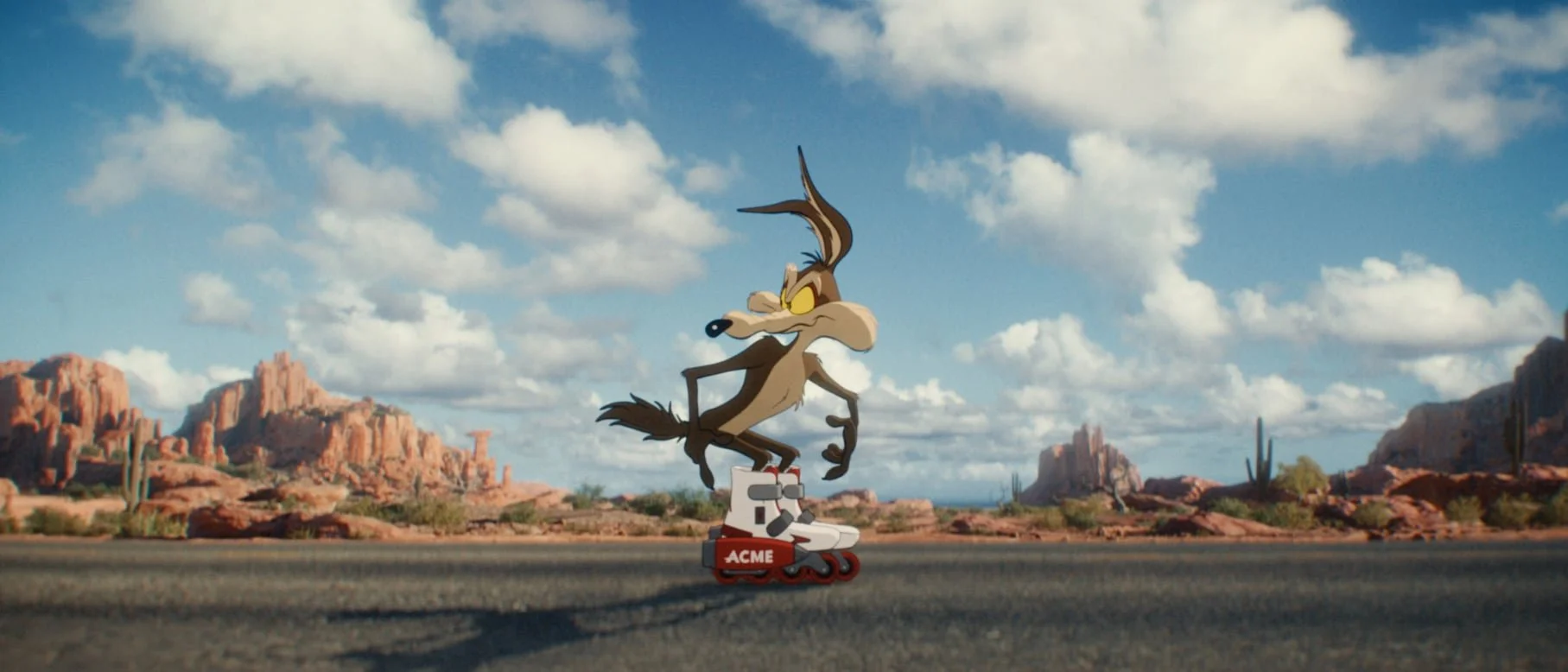
With about thirty years' worth of context in mind, one would hope that a film with such metatextual baggage would justify its many years in development hell. Color me pleased to report that it’s even better than expected. Some of my emotional response to Coyote vs. Acme certainly comes from the multiyear trek to the multiplex, but I would’ve enjoyed this film either way. It’s ingenious on premise alone, with director Dave Green, along with May December screenwriter Samy Burch (who shares story credit with Jeremy Slater and James Gunn) taking the concept to its fullest potential. It’s chock-full of great comedic gags (the rocket skates from Frazier’s article make an appearance), but surprisingly contains a potent emotional core.
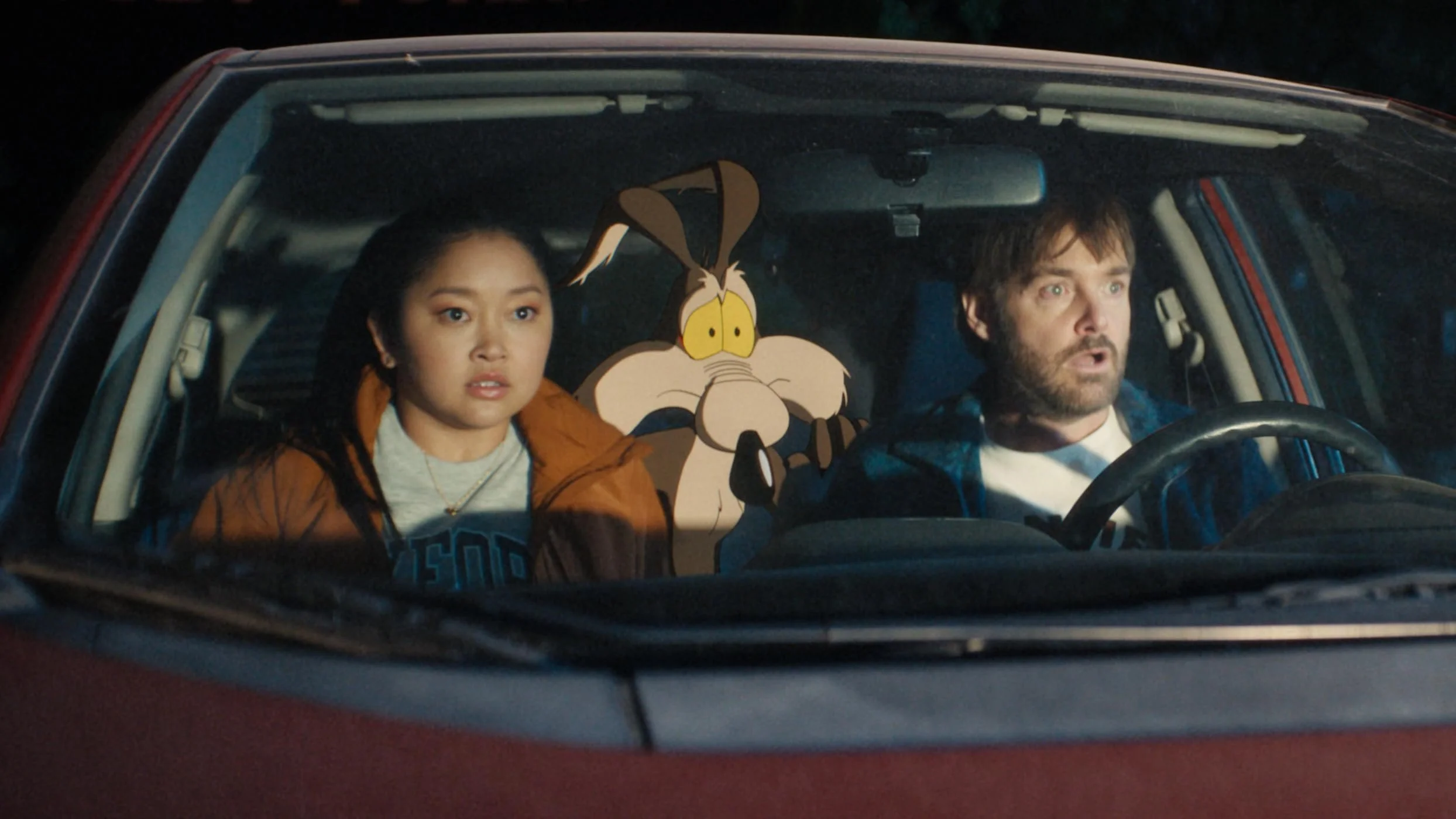
Defending Mr. Coyote is Kevin Avery (Will Forte), a capable yet burnt-out personal injury lawyer who settles for meager payouts at any opportunity. He’s not interested in lawyering anymore; he just wants to get the cases over with for a quick buck. Assisting Kevin is his niece, Paige (Lana Condor), an idealistic young intern who believes there’s a greater case at play than a triple-digit payout. As their defense mounts and stakes become personal, the Averys uncover a greater conspiracy at play, colluding with carrot-munching whistleblowers to reveal just how deep the wabbit hole goes. Learning the power of perseverance from both Paige and Wile E. Coyote’s masochistic Road Runner hunt, Kevin regains his mojo and rises to the occasion.
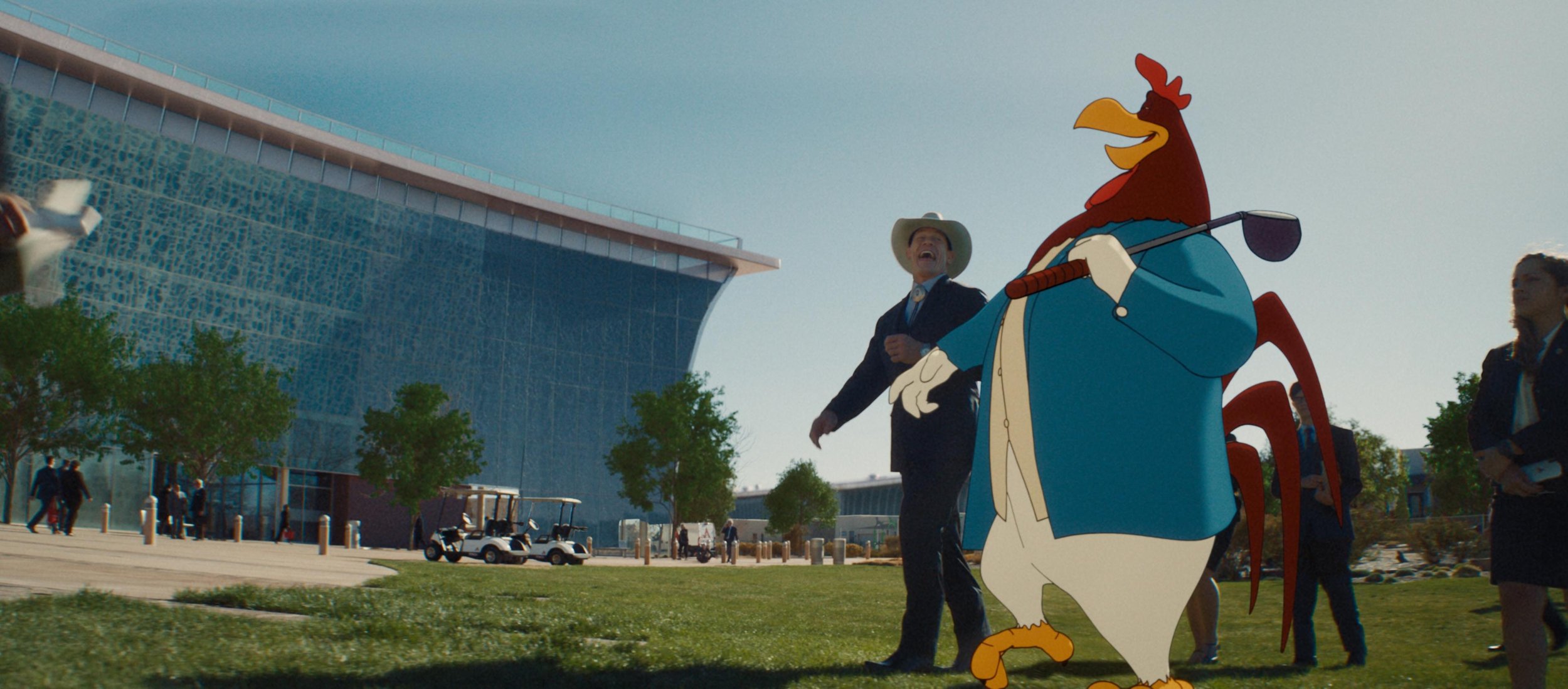
Representing the Acme Corporation is the ultra-charismatic Buddy Crane (John Cena), one of Kevin’s former classmates at Harvard Law. Under the pompous beak of Acme exec Foghorn Leghorn (one of Eric Bauza’s multiple voice roles in the film), Acme will stop at nothing to snuff out both case and conspiracy at all costs. As with his beloved turn as Peacemaker in The Suicide Squad, Cena’s deadpan delivery remains his greatest comedic attribute, with a plethora of line deliveries from the former wrestler that split my sides with raucous laughter. He perfectly personifies the Cheshire Cat-grinned fakeness that defines corporate culture–a testament to both Cena as a performer and Burch as a satirist. Such wouldn’t be funny if it weren’t true.
Compared to Looney Tunes icons like Bugs Bunny, Daffy Duck, and Porky Pig (also voiced by Eric Bauza), Wile E. Coyote isn’t exactly an A-lister. He’s a character designed to be the butt of the joke, but Coyote vs. Acme is the first time when Wile E. Coyote had any interiority as a character. Opposed to the usual desire for him to run so hard into a wall that it leaves a coyote-shaped hole, you actually want Wile E. Coyote to succeed. Catching the Road Runner remains his overarching objective, but that goal is placed on the back burner in favor of a bigger fish. Or, in the case of Foghorn Leghorn as an uber-rich Acme exec, a bigger bird.
Emotions peak as the Averys, alongside Wile E. Coyote, garner support from the other Looney Tunes characters in their quest to get Acme their just desserts. It’s honestly somewhat similar to the emotional climax of Spider-Man: Brand New Day, as both Spidey and Wile E. learn that they’re not in this world alone, with a cavalcade of friends standing behind them. You feel for both animated and live-action characters, whether it’s Kevin’s bounceback, Paige’s pluckiness, or Wile E.’s court proceeding. I’m not afraid to say that I felt my tear ducts flex when a certain character took the stand at the trial, which is the last thing I expected from a film of this caliber.
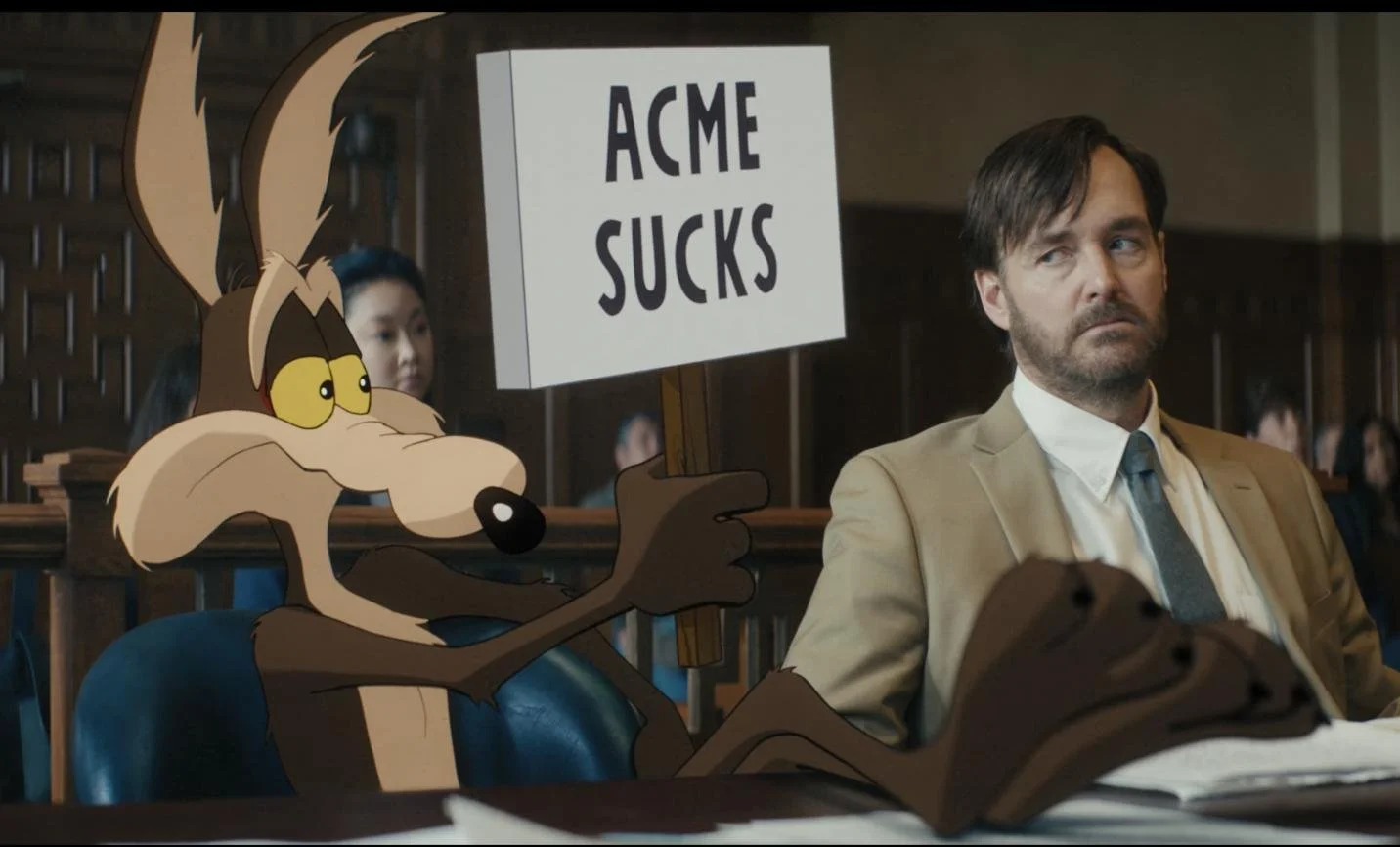
Existing as one of the few live-action-animation hybrid films of the 2020s (preceded by Chip ‘n Dale: Rescue Rangers, Space Jam: A New Legacy, the recent SpongeBob films, and the 2021 Tom & Jerry movie), there’s merit to the collision of visual languages on display in Coyote vs. Acme. There’s a weight to how the animated characters interact with their live-action surroundings, whether that be through Wile E. Coyote’s various traps or Taz’ cyclonic chaos. The animation style mimes the traditional 2D Looney Tunes look through contemporary 3D animation, and looks excellent for a film once deemed unreleaseable. There is an air of the made-for-streaming look, but I’m willing to look past the minutiae in favor of a worthwhile end product.
After a years-long struggle that would give Sisyphus a run for his money, Coyote vs. Acme is much more than a Who Framed Roger Rabbit?-style Looney Tunes comedy. It’s an anti-capitalist, pro-consumer comedy with stakes stretching beyond the screen, and the fact that people can see the film is itself a massive win for the underdogs–whether that be the consumer or the creatives involved with Coyote vs. Acme. Thanks to indie distributor Ketchup Entertainment (who also handled The Day the Earth Blew Up, another Looney Tunes film Warner Bros. tried sweeping under the rug), Coyote vs. Acme’s theatrical release feels like a step–however large–in the right direction for Hollywood. The war isn’t over, but the battle is won.