
Movie Review: Nicolas Winding Refn Wears His Heart On His Sleeve With "Her Private Hell"

7/12 ForReel Score | 3/5 Stars
Vapidity, at this stage, is all around us. Everything as far as the eye can see is coated in layers of artifice; a desperate attempt to make something out of nothing. Call me an old man yelling at clouds, but our era of content-ification, online numerics, and faux-presentation encases all that is human within a glass-onion-like veneer. Or, maybe that's just my ass-backwards rationale for enjoying Nicolas Winding Refn's first cinematic endeavor in ten years: Her Private Hell. Conceived after Refn died for twenty-five minutes in 2023 due to a “leaky heart” (an ironic medical dilemma for Death Stranding’s “Heartman”), Her Private Hell is less of a conventional cinematic narrative than it is a collagic moodboard of aesthetics and anxieties.
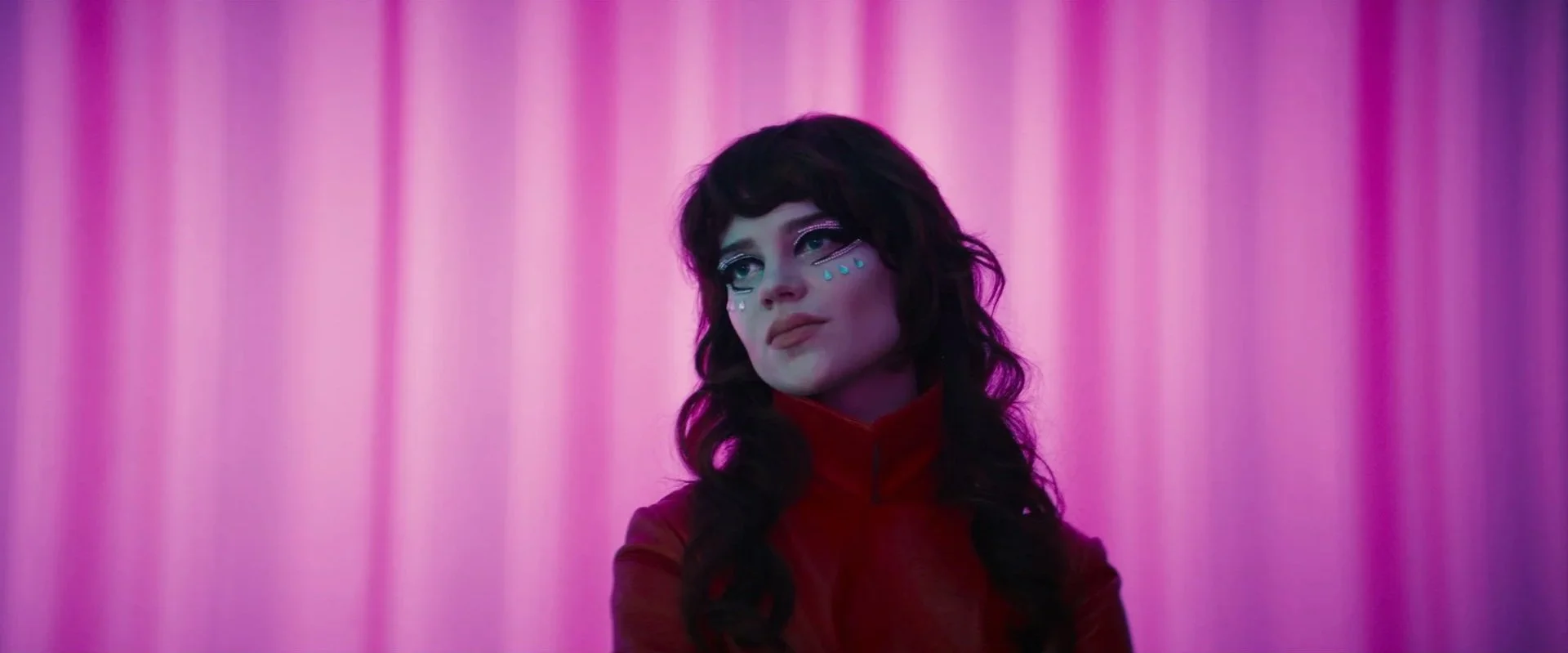
Image courtesy of Neon
As an avid, vocal cinephile, I've often found myself at a crossroads in the debate between style and substance. On one hand, I like having something to chew on—a film I can mull over for hours on end. On the other hand (which holds a lollipop and wears a propeller hat), I also like shapes and colors. Maybe it's a cop-out to say “the style is the substance,” but I can't change how I feel. Coherence is for the birds; give me psychosexuality, neon lights, and the muscular curvature of Charles Melton’s sculpted physique. Refn knows damn well that his half-Suspiria, half-Blade Runner pastiche is like Cocomelon for a perpetually stoned cave-dweller such as myself, although your mileage may vary.
Hollow as the film may seem, much of that hollowness is an intentional, alienating choice. Line deliveries are beyond stilted and platitudinous, which, though quite funny, fill the air with an astonishing amount of nothing. “Characters” (if you can call them that) ramble about stardom, follower counts, and Elle’s filmmaker father, “Johnny Thunder” (Dougray Scott), who can strike a match on almost any surface. It may be an insult to David Lynch to dub Her Private Hell “Lynchian,” though Refn’s examination of female sexuality and dream logic evokes—to a lesser degree—that of Mulholland Drive. For a film summarizing his near-death and fear of leaving his daughter behind in an unrecognizable hellscape, Her Private Hell is Refn at his goofiest.
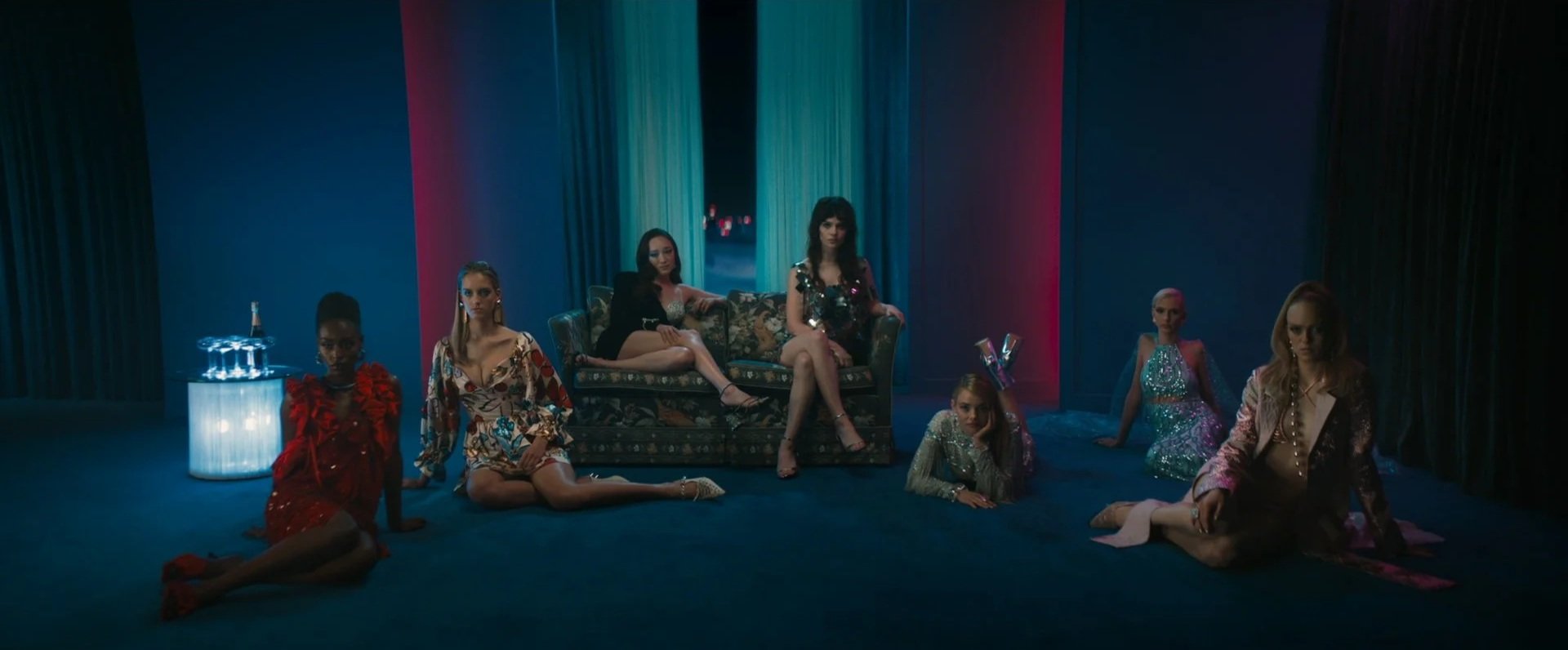
Image courtesy of Neon
For a film tackling Refn’s Lazarus-like death and resuscitation, Her Private Hell needed to be as experientially stylistic as possible. Thankfully, style is Refn’s bread and butter. Staggering images of blurring cityscapes and sci-fi film sets fold in on each other like only dreams can, drifting from one phantasmagorical location to another in a hazy fugue state. Jagged hands protrude from the Earth; skyscrapers are fitted in the shapes of skulls; an unexplainable mist pervades the metropolitan cross between Copenhagen and Tokyo. The actors are ethereally gorgeous, always wearing dazzling clothes or makeup (apart from a mostly-shirtless Charles Melton). Even though barely anything properly coalesces in the end, I found Her Private Hell to be utterly entrancing.
Wholly indebted to giallo cinema, Her Private Hell is Nicolas Winding Refn’s attempt at homaging both Dario Argento and Brian De Palma, with legendary composer Pino Donaggio bridging the gap between Refn’s influences. One plotline, à la Suspiria, follows Elle (Sophie Thatcher), an actress involved with a comic book, sci-fi production. Meanwhile, in a more Refn-like B-plot, the quiet yet brooding Officer Kay searches the kaleidoscopic cityscape for his missing daughter. Connecting these two threads is the presence of “The Leather Man,” a bedazzled, girl-hunting serial killer that comes with an all-encompassing blanket of mist. At no point do these ingredients exceed homage, though it’s certainly a palpable vibe; one that I’ll certainly find myself revisiting after smoking a joint.
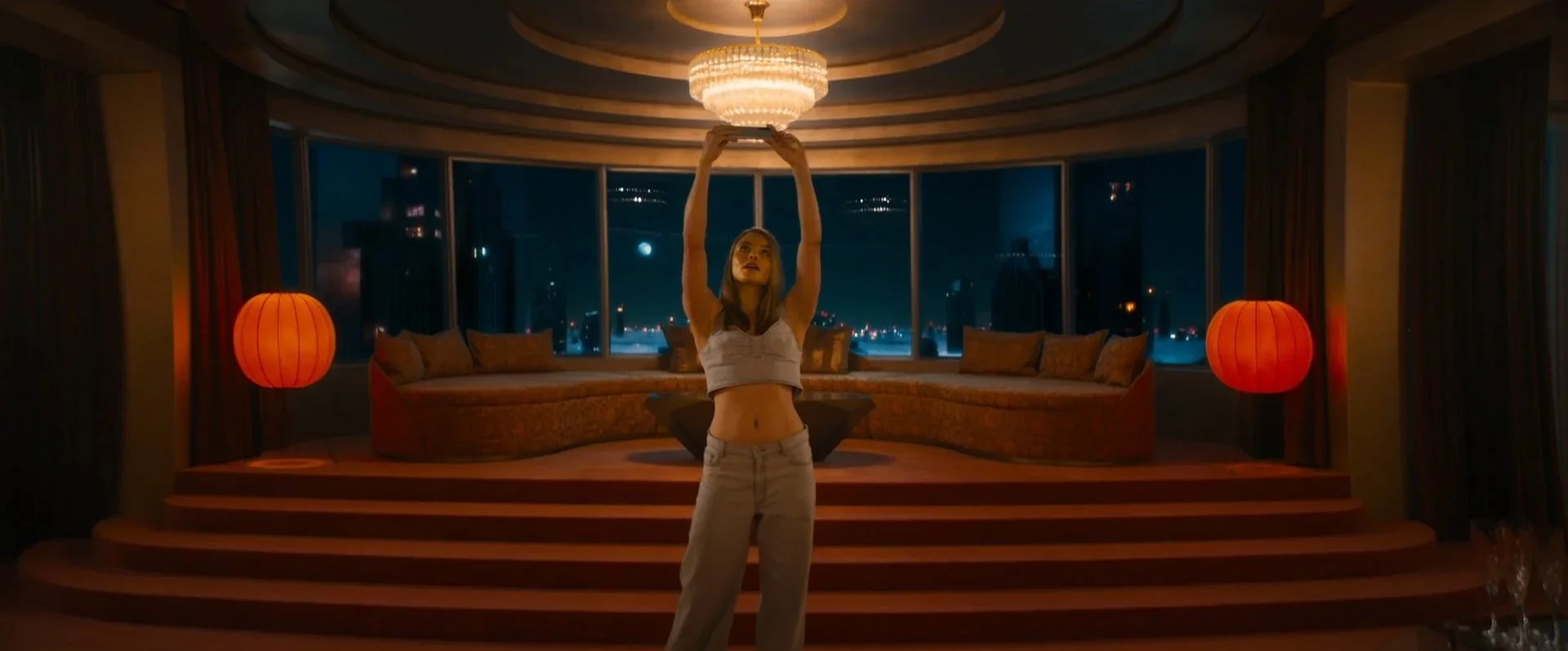
Image courtesy of Neon.
If Her Private Hell is about anything, then it’s about how terrified Nicolas Winding Refn is of abandoning his daughter in such a bizarre world. Between Elle and her father’s relationship and Kay’s vengeful quest to find his missing daughter, Her Private Hell’s anxieties are placed on an alternate reality where Refn died and left his daughter to her own devices. As with his Freudian thriller Only God Forgives, Refn has always been one to interrogate sexuality in an uncomfortably incestuous way, with Her Private Hell angling towards anxieties of his daughter entering an unknowably artificial world of sexuality, vapidity, and violence. It’s a horror film for Refn and Refn alone; therapy by way of cinematic catharsis.
Nowhere in good conscience can I say that one will come out of Her Private Hell with a changed outlook on life (or Refn, for that matter), but this film is more for Refn than it is for us. This is an auteur—one of the world’s strangest and most divisive—working through his worries in the only way he knows how, concluding that, when the time comes for Refn to leave this mortal coil, his daughter will be okay without him. Outrageously goofy as Her Private Hell is (I cannot believe Refn snuck this into Cannes), it’s also Refn’s most sentimental film since Drive. Most will find Her Private Hell utterly detestable, if not boring, though I found it mesmerizingly bittersweet.
A smattering of neon-lit ideas across the silver canvas, Her Private Hell is a gorgeous mess of sexuality, graphic violence, cultural critique, anxiety, cinephilia, and familial love. Meant for both Refn auteurists and Refn himself, Her Private Hell will certainly bounce off, if not aggravate, most viewers. It’s remarkably dense for a text so outwardly empty, ornate with dreamlike red herrings and non sequiturs; rarely have I seen a film so entrancingly contradictory. Deliberately indecipherable and convoluted as Her Private Hell is, I can’t seem to excise the hypnotic allure of Refn's images from my mind’s eye (what’s the movie version of an earworm?). In the words of Knives Out’s Benoit Blanc: “It makes no damn sense. Compels me though.”