
Movie Review: "The Odyssey" Abides By Nolan's Law - Go Big And Be Epic

12/12 ForReel Score | 5/5 Stars
Growing up in the “gifted students” program, I was taught Latin in elementary school. Before linguistics, though, was Greek mythology. From kindergarten to third grade, our “magistra” read us (accessibly G-rated) stories of heroes, Gods, and monsters; a real adrenaline shot to the imagination. And, when I wasn't at school, I was either reading the Percy Jackson books or watching Ray Harryhausen films in my spare time. This drip-feed of mental and celluloid imagery collided during our reading of The Odyssey, searing itself into my mind's eye. Translating such a text to the screen is a Herculean task, one that British auteur Christopher Nolan doesn't take lightly in his apocalyptic, colossal, hopeful adaptation of Homer's epic poem.
After making one of the defining films of the century with the Oscar-winning Oppenheimer, to say Christopher Nolan had carte blanche for his next venture would be an understatement. Not only is he the president of the DGA (something Guillermo del Toro teases him for), he’s arguably the 21st century’s defining auteur. Starting as an M. Night Shyamalan-esque puzzlemaster before going big with The Dark Knight trilogy, Nolan, for lack of a better phrase, makes shit happen. He’s the guy who crashed a plane on IMAX 70mm film; he’s the guy who recreated nuclear physics with ping-pong balls and paint. With The Odyssey, Nolan imbues his David Lean and Ray Harryhausen influences into his most grandiose work yet.
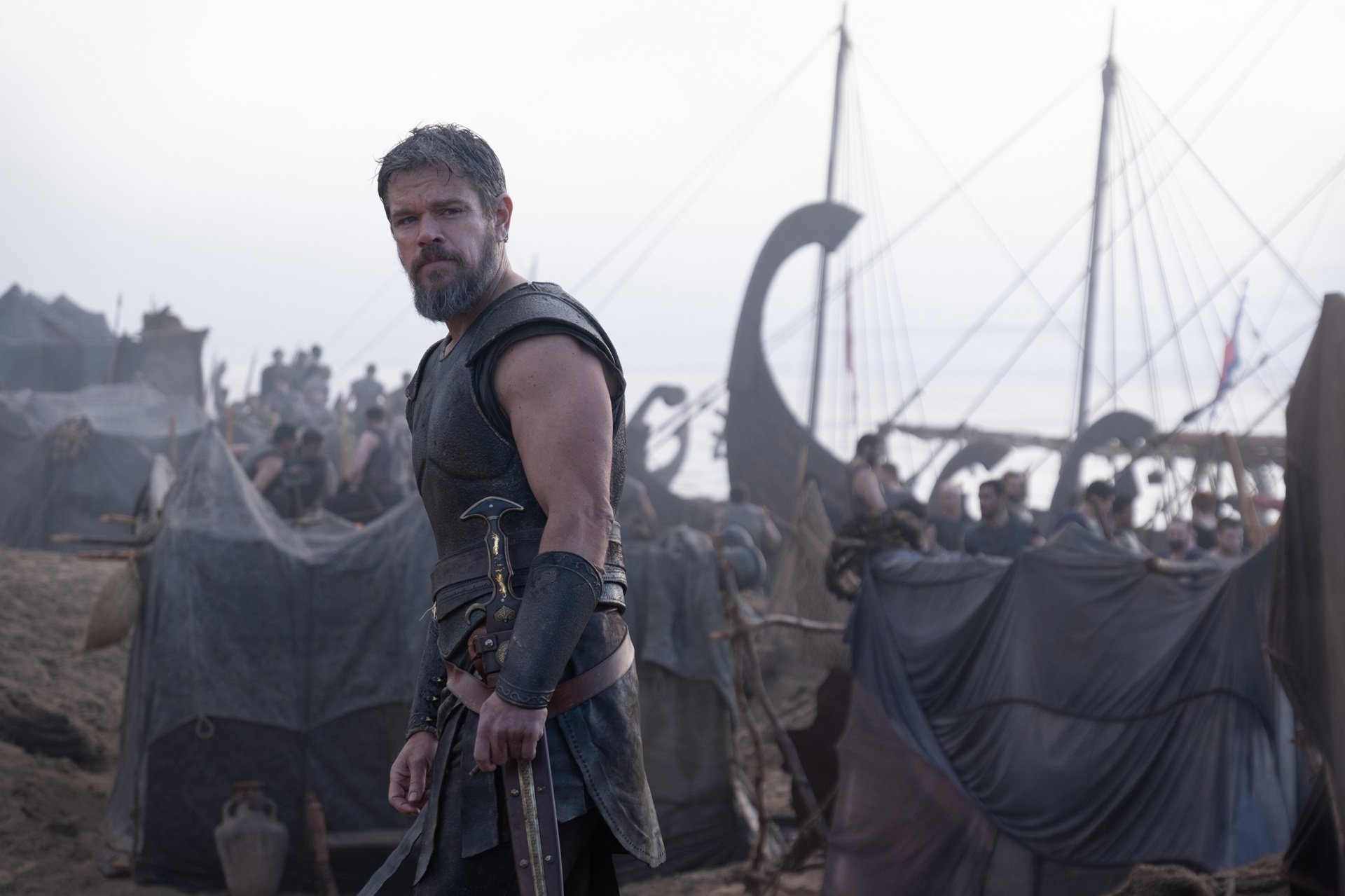
Image courtesy of Universal Pictures
If you know the slightest thing about Christopher Nolan, it's that he's not one to cut corners. If the story demands a cyclops, you best believe there will be one. Nolan’s all about pushing the boundaries of what you can do with the moving image, and The Odyssey is further indication of his ability to bring the impossible to life. His thirteenth film marks his first venture into the fantastical, though he still brings a grounded approach to “a time of apparent magic.” It's easily his weirdest effort as a filmmaker thus far, and Nolan brings that macabre strangeness in spades. Say what you want about Christopher Nolan, but The Odyssey is an undeniable achievement of blockbuster filmmaking.
Given that accuracy—either historical or textual—has been a nails-on-the-chalkboard-level talking point since The Odyssey’s 2024 announcement, let’s get down to brass tacks. On one side of the battlefield sits those who believe that the inclusion of minorities is a stain against their Christo-fascist “culture” - vocal ignorance that frankly bothers me. In contrast, the other camp has more justifiable concerns regarding Nolan’s adaptive process. I couldn't care less about the costuming (sorry guys, Agamemnon looking like Darth Vader is sick) or anachronistic dialogue (see: Marty Supreme), as the rub lies beneath bronze plating. We have the who, the what, the when, the where, and most of the how, but why did Christopher Nolan adapt The Odyssey at this moment in time?
Coming off Oppenheimer’s seven-statue sweep at the 96th Academy Awards (including Best Picture and Best Director), all eyes were on Christopher Nolan in anticipation of his next move. Early rumors claimed he was remaking Jon Badham’s Blue Thunder, though Universal Pictures quickly quashed them upon The Odyssey’s announcement. It’s easy to remark on the alienating divisiveness of our modern world, but Nolan asserts that we’ve lost something essential to our humanity long ago. Xenia—the ancient Greek ideal of hospitality—is a throughline regarding how humans should treat one another and contrasts with the horrific barbarism of the Trojan siege. Akin to his depiction of the atomic bomb’s inception and its sylleptic fallout, Nolan illustrates Troy’s ransacking as an original sin-like event.
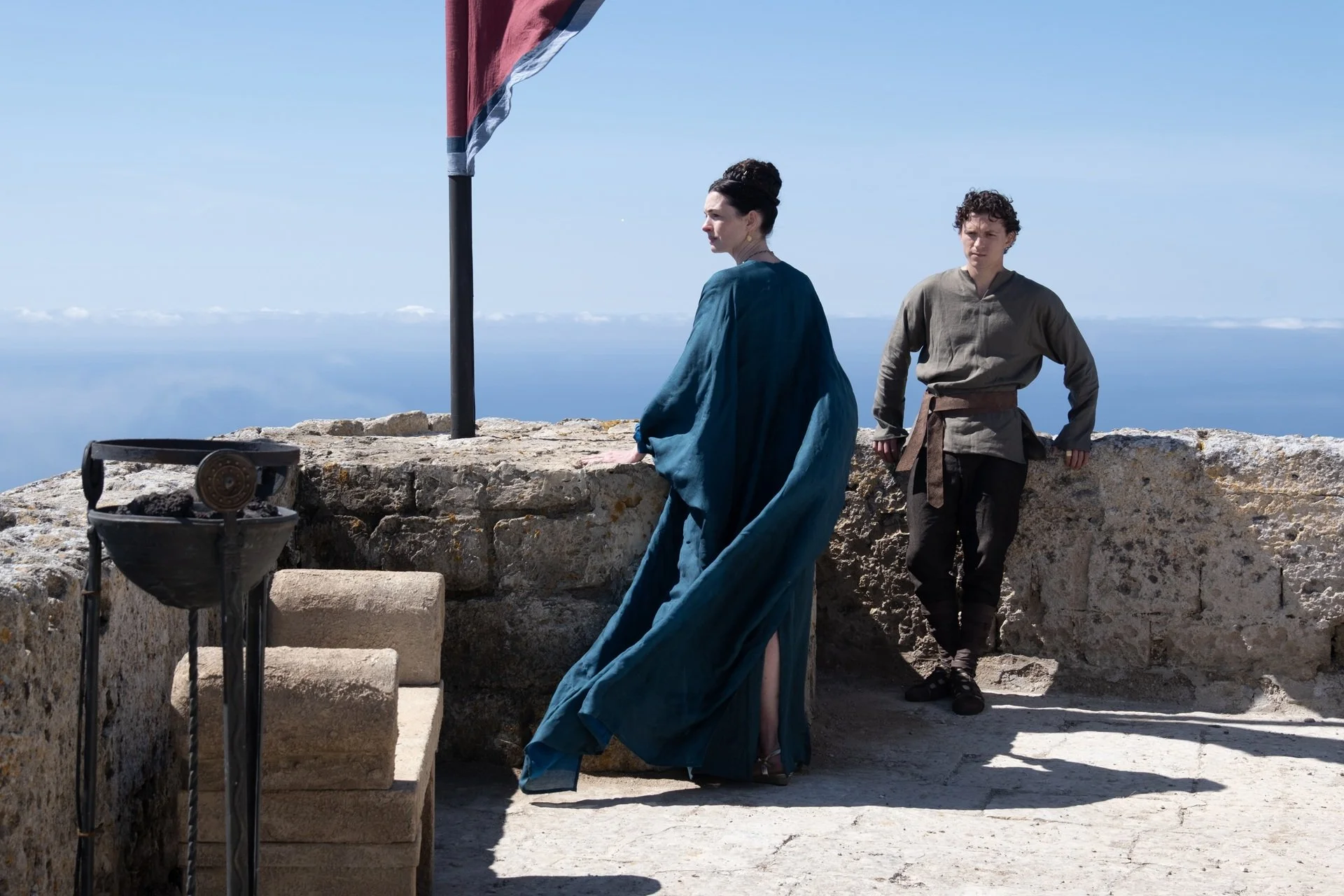
Image courtesy of Universal Pictures
Adapting a 3,000-year-old text for modern audiences—particularly for a maximum runtime of three hours—throws much on the cutting room floor, though Nolan’s amendments to the material make his argument of humanity stick out all the more. Miffed as I am about the exclusion of the “Nobody” trick, the circumstances of its omission evoke the modern principle of “shoot first, ask questions later.” Rather than turning Odysseus’ men into pigs in an instance, Circe’s famously porcine sequence toes the line of body-horror. Such deviations may leave fans of the source material disappointed, though there's always intention behind what Nolan chooses to include. It's partially an exercise in directorial and narrative restraint, and partially an exercise in cinematic necessity.
Meanwhile, The Odyssey slots itself comfortably into one of cinema’s funniest running jokes: the “We Need to Find Matt Damon” saga. Between Saving Private Ryan, the Bourne series, The Martian, Interstellar, and five minutes of Ocean’s Eleven, Matt Damon is one of the most sought-after faces on and off-screen—and for good reason. I’m not even going to begin fathoming the physical hell Nolan put his cast and crew through, but Damon rises to the occasion of playing Odysseus with a smug, thorny arrogance. Odysseus is one of fiction’s most notorious connivers; a morally grey “hero” by all senses of the word, something that neither Nolan nor Damon took for granted. Odysseus may be The Odyssey’s protagonist—a hero he is not.
Haunted by visions of Athena (a sparingly used but expertly utilized Zendaya), Odysseus’ regretful internal struggle is The Odyssey’s driving force. Smart as Odysseus may be, he's not always the best decision-maker, leading many of his compatriots into certain doom. Shot on the blackened beaches of Iceland, the scene in Hades reads as an evil version of the afterlife scene from Terrence Malick's The Tree of Life, as Odysseus and his crew meet the casualties from during and after the Trojan War. Both his brashness and inner turmoil are best displayed in the siren scene, where Odysseus wails in agony while tied to his ship’s mast. Tormentedly yet powerfully affected, Damon’s Odysseus might be the actor’s best performance so far.
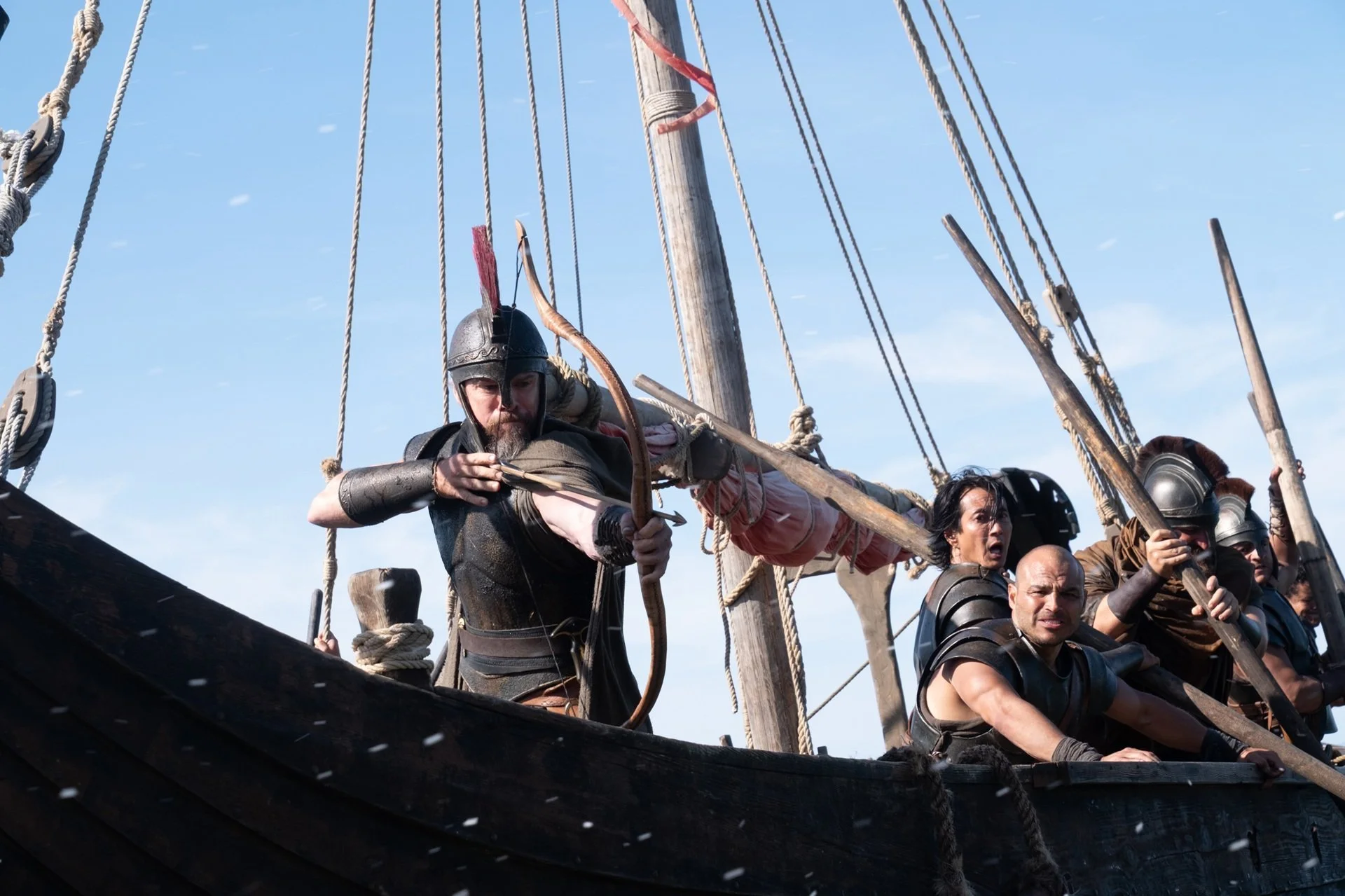
Image courtesy of Universal Pictures
Joining Damon are Tom Holland (with the most emotional intensity I’ve seen from the web-head) and Anne Hathaway, whose turn as Penelope serves as an excellent mirror to Odysseus’ cunning. Between standouts like Lupita Nyong’o’s dual role as the regretful Helen and vengeful Clytemnestra, Himesh Patel as the skeptical Eurylodus, or Robert Pattinson as the scheming Antinous, everyone involved brought their absolute A-game. The crown jewels of Nolan’s arsenal, though, are John Leguizamo as Odysseus’ shepherd Eumaeus, Samantha Morton as the sorceress Circe, and especially Elliot Page as one of Odysseus’ loyal soldiers, Sinon. Serving as the emotional centerpiece for Nolan’s commentary on warfare’s dehumanizing ripple effects, Page’s performance as Sinon is The Odyssey’s skeleton key.
Christopher Nolan’s previous two films establish a quasi-trilogy about his fears of leaving the fate of this cruel, beautiful, unknowable world to his children, as The Odyssey bridges the gap between its predecessors. Where Oppenheimer prophesied global annihilation and Tenet suggested the possibility of amending our mistakes, The Odyssey argues that what humanity lost can return one day. It’s a recognition of the world's foundations crashing around us, with the hope that something new—something better—can come from the many mistakes we’ve made as a species. Alongside Interstellar and Oppenheimer, The Odyssey is one of Nolan’s most personal films to date, and maybe his most pragmatic. A juggernaut in both scale and sentiment, The Odyssey is simply the real deal.
As with all Christopher Nolan films, I'll need a rewatch (maybe more than one) to truly see where my heart aligns on such a gargantuan work. My childhood mental vignettes of Homer’s Odyssey have been outmatched by the sheer scale of what Nolan managed to pull off, and I'm simply dumbfounded. Only Christopher Nolan (and maybe Denis Villeneuve, in a few years) is capable of taking blockbuster cinema to its absolute breaking point, going above and beyond to create images unlike anyone has ever seen. For all intents and purposes, he's simply one of the finest working directors to walk the Earth. Adding another masterpiece to his already-stacked arsenal, I can't even begin to imagine what Christopher Nolan does next.