
TIFF 2026 | Movie Review: "Hope" Matches the Hype, Overcoming Minor Flaws With Major Entertainment

10/12 ForReel Score | 4/5 Stars
Hype trains go one of two ways: breakout success or colossal failure. With three months left in the year, 2026 is stacked when it comes to film-centric excitement, whether it’s for film festival juggernauts like Cristian Mungiu’s Fjord or major tentpoles like Denis Villeneuve’s Dune: Part 3. Bridging that festival-blockbuster gap is Hope, the newest action romp from South Korean auteur Na Hong-jin. It’s possibly the strangest film to vie for Cannes’ Palme d’Or since 2024’s wombo-combo of Megalopolis and Emilia Perez, garnering quite the mixed spread of out-of-theater reactions. Such gaps in audience response entice my morbid curiosity, though there’s no preparing for Hope’s idiosyncrasies. I expected an all-out genre rollercoaster from Hope, and instead found something much toothier.

Hot off its world premiere at Cannes’ Grand Théâtre Lumière, the buzz surrounding Hope was impossible to ignore. Comparisons ranged between Michael Bay’s Transformers films, Ari Aster’s Eddington, and Steven Spielberg’s War of the Worlds, with none of them being off-base. Marking Na’s fourth film after 2016’s The Wailing, Hope fittingly centralizes the citizens of its eponymous township—particularly their chief of police, Bum-seok (Hwang Jung-min), and his hunter cousin, Sung-ki (Zo In-sung). The cousins converge on the town outskirts, where a mutilated cow corpse lies on the road. The gashes are too precise for the culprit to be any local animal, so what tore up the bovine? Turns out, the answer is a few steps ahead of everyone else.
Back in the town, though, the mystery organism wreaks absolute havoc. Following the Jaws formula of creature concealment, we’re less privy to what the monster is compared to the damage it’s wrought. Bum-seok constantly lags behind the unfolding carnage, establishing a thematic throughline of police incompetence and structural instability found in all three of Na’s previous films. Hope is neither as suffocatingly bleak as The Wailing nor as tightly-wound as The Chaser; it’s the best (and worst) of both worlds. It peaks at mind-boggling highs and stoops to head-scratchingly bizarre lows. The collision between methodical police procedural and Predator-esque action is both white-knuckle and lopsided, though Hope’s first hour undoubtedly delivers pure adrenal euphoria.

As transcendentally vigorous as Hope’s filmmaking is, one can’t ignore the extraterrestrial elephants in the room: the visual effects. The creature designs are horrendously realized, as even the characters in the film concede the repugnancy of their interplanetary adversaries. The CGI is barely up to par with Hope’s spiritual predecessor, Bong Joon-ho’s The Host, though the latter film is twenty years old. Any clear look at the monsters (Michael Fassbender, Alicia Vikander, Taylor Russell, and Cameron Britton in mo-cap) requires a subsequent eye-bleaching; it's only effective when in motion. The aliens move with such tremendous speed and force that the early-Xbox graphics become negligible, as their looks pale in comparison to how they interact with their environment.
Representing the home team against Hope’s cosmic crusaders is a beyond-capable ensemble led by Hwang Jung-min (previously a shaman in The Wailing) and Zo (also in Lee Chang-dong’s upcoming Possible Love), loaded with heroes, villains, and delightful cannon fodder. Hwang’s Chief Bum-seok bumbles through the town ruins with a local named Nak-yeon, before the heavy artillery comes in via a true movie-star performance from Squid Game’s Hoyeon. Hope may be far less character-driven (apart from Hoyeon, who straight-up steals the show) than any of Na’s previous features, though no characters are without dimension—the human characters, at least. Maybe Hope could’ve used less action and more character drama, but that doesn’t seem like the movie Na wanted to make.
Clunky as the effects are, when Hope moves, it moves. If you can overlook the visual effects, Hope’s action is rapturous to behold. Kudos to Forged Films (Na’s production company) for posting behind-the-scenes footage on their socials, because I’d have no idea how they filmed this otherwise. Hope’s car chases and horseback shootouts are true sights to behold, which mostly compensate for the butt-ugly monster effects you’ll either have to ignore or endure. Na builds towards the action with potent atmosphere, imbuing the film with dread, confusion, and sparse humor. Were it not for the awful CGI and nonsensical setup ending for a sequel that may never come out (though already written), Hope could’ve been a true sci-fi-action classic.
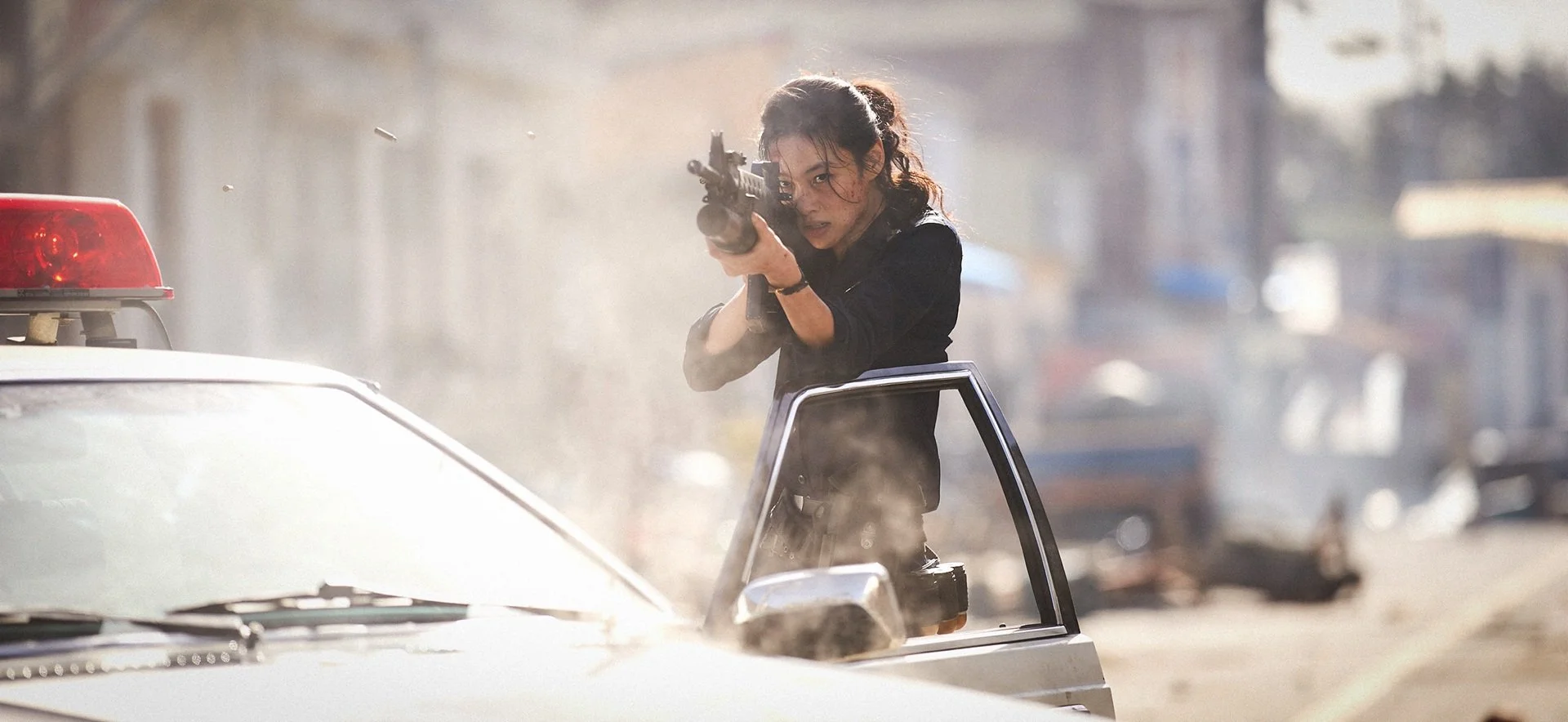
Functioning as both a police procedural and a muscular action thriller, Na’s sense of propulsion—either narratively or directorially—is what makes Hope so great (on the surface, at least). Shooting with the widest lenses possible in vast open spaces, Na and legendary cinematographer Hong Kyung-pyo (best known for his collaborations with Bong Joon-ho) make the Hollywood-iest film in South Korean history. Whether that’s a good thing or a bad thing is up to you, but Na is wholly aware of how intentionally Westernized Hope is. It’s a comparable mode of pastiche as Jordan Peele’s similarly named Nope, with most of that connective tissue coming from composer Michael Abels’ magnificent score. Most importantly, though, Hope never strays from its distinctly Korean identity.
Behind the veneer of a Hollywood blockbuster, Hope is a deft commentary on the lasting effects of the Korean War and the resulting Westernization of South Korea. A running joke throughout the film is Bum-seok’s befuddlement as to how Hope Harbor’s inhabitants have American-made guns, while casual mentions of active minefields allude to the ongoing ceasefire between North and South Korea. Some of the rub is in casting Western actors as your invading force, though Na digs deeper than moral binaries. The Wailing previously interrogated Korean persecution complexes through the lens of Japanese colonialism, whereas Hope pivots to South Korea’s unhealed postwar anxieties and Westward shift. Those wanting all-gas-no-brakes action will be disappointed, though Hope will greatly reward one's patience.
Going into Hope, I was practically rattling with excitement. Now, I’m simultaneously impressed and baffled. While Hope undeniably delivers as a sometimes masterful action vehicle, the remaining aspects are simply impossible to ignore. It’s a bit disappointing to see a film just shy of true, unadulterated greatness, though mismatched expectations could very well be to blame. All I know is that I’m itching for a more informed rewatch, regardless of Hope’s glaring flaws. Certain stretches irrefutably contain “best of the year” material, while some shots killed me and sent me to action-movie heaven. Maybe that forthcoming sequel can iron out some of the film’s visual and narrative kinks (seriously, what the hell was that ending?), but one can only hope.