
Movie Review: '28 Years Later: The Bone Temple' Succeeds With Nia DaCosta At The Helm

10/12 ForReel Score | 4/5 Stars
Roughly 28 weeks have passed since Danny Boyle and Alex Garland revived the 28 Days Later franchise with the boldly emotional 28 Years Later, a subversive gem for the otherwise dormant zombie subgenre. In that time, I’ve waited with bated breath for its swiftly approaching sequel, subtitled The Bone Temple, directed by Nia DaCosta. Coming off the heels of her awards-season contender Hedda – adapted from Henrik Ibsen’s Hedda Gabler – DaCosta takes a full 180 in going from an elegantly thorny psychological thriller into gnarly post-apocalyptic horror. I’m a fan of DaCosta for her 2021 Candyman requel, but the lack of Boyle and DP Anthony Dod Mantle returning definitely raised eyebrows among 28 fans. Fortunately, DaCosta successfully follows Boyle’s footsteps while leaving room for a fantastic third entry.
Danny Boyle left some massive shoes to fill after knocking my socks off with 28 Years Later, but giving Nia DaCosta the reins for The Bone Temple was a smart move in making sure that these films still feel fresh and organic. Alex Garland’s groundwork is still laid with a smaller scope than its predecessor, but the presentation gives The Bone Temple a distinct feel while maintaining the trademark digital photography of the 28 films – nobody involved is dumb enough to let lightning strike twice. Nia DaCosta’s direction is sharp and has hints of what Boyle was doing in the previous film, but she, alongside DP Sean Bobbitt and composer Hildur Guðnadóttir, make The Bone Temple entirely their own. It feels less like “28 Years Later 2” than it does a 1.5, often having the vibe of a high-quality DLC for a video game.
28 Years Later left off on the meeting of protagonist Spike (Alfie Williams) and the-to-be villain “Sir Lord” Jimmy Crystal (Jack O’Connell), with the latter offering to be “pals”. Picking up mere minutes after Spike’s encounter with Jimmy’s Teletubby-inspired Jimmy Saville-styled ninja satanists (I would absolutely love to see what the screenplays for these movies look like), Spike quickly learns that he’s in bad company and is unwillingly taken under Jimmy Crystal’s wing. Joined by seven marauders he dubs his “fingers,” O’Connell’s Jimmy Crystal is a megalomaniac who weaponizes religion to justify his cult’s barbarous acts of violence, claiming that their victims are sacrifices to “Old Nick,” or Satan. He’s representative of all the leaders who have used religion to justify acts of violence, and how promises of holy absolution or threats of divine punishment are nothing more than manipulation tactics.
Taking a page out of The Last of Us’s playbook (which took multiple pages out of 28 Days Later’s playbook), The Bone Temple is primarily interesting because it’s a zombie apocalypse movie with human antagonists. Sure, there’s some great zombie carnage with stringy, sinewy bite makeup and fun kills, but most of the threat in The Bone Temple comes from Jimmy Crystal and his Jimmy gang. They’re skinning people alive and suggest they’ve done much worse than what we’ve seen, and the young Spike is constantly in peril under the thumb of Jimmy Crystal. Less than a year after becoming an icon as Remmick from Sinners, Jack O’Connell is back again in a role that might just be scarier than the former. Jimmy Crystal isn’t a vampire or a zombie that kills for nourishment; he’s a human who kills for amusement.
Running parallel to Jimmy’s storyline is a tighter focus on Dr. Ian Kelson (Ralph Fiennes), the sentimental survivalist architect of the Bone Temple. Kelson quickly became a fan-favorite after his introduction in 28 Years Later, and it’s clear that writer Alex Garland does too, considering that Kelson is the de facto protagonist of this film. He’s developed something of a transactional quasi-friendship with a zombie he’s named Samson, and starts to ponder the psychology of the infected. Never before in a zombie movie has a zombie actually become a character within the story, but that humanist angle is sprinkled all over the 28 Years Later films; look no further than the zombie birth scene from the movie prior. It’s not as emotionally impactful as the last film, but there’s a moment here where I definitely found myself getting choked up.
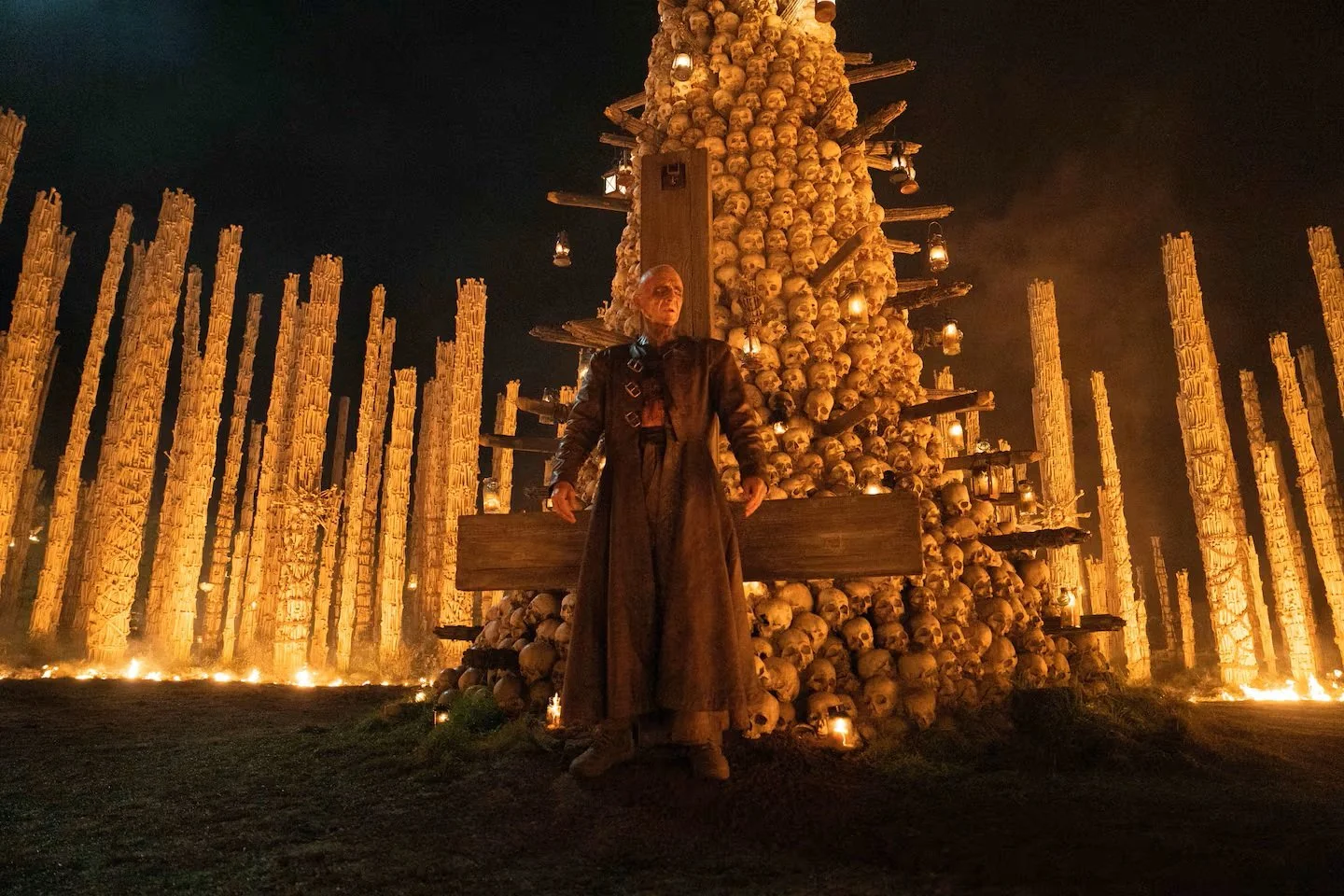
As the trailers have vaguely teased, these concurrent plotlines eventually merge to a point at which Jimmy’s gang of bandits – with Spike in tow – arrive at the Bone Temple, and everything from that point on is simply batshit insane. Ralph Fiennes puts on an animalistic performance that is unlike anything I have ever seen him do, and Nia DaCosta’s imagery of a fiery Bone Temple is nothing short of dazzling. Accompanied by an absolutely insane needle drop, it’s an astonishing display of pyrotechnics in a truly bizarre sequence that nobody will see coming. Fiennes is literally bouncing off the walls in occult makeup and blackened teeth, and it’s as goofy as it is spellbinding to watch. When it’s all said and done, it wouldn’t be a stretch to say that Dr. Kelson is one of the best characters in zombie movie history.
Considering that The Bone Temple was shot immediately after the filming of 28 Years Later, Nia DaCosta’s follow-up is a more-than-worthwhile exercise in world and character building that sufficiently passes the baton back to Danny Boyle in what’s sure to be a fantastic conclusion. In the hands of a lesser filmmaker, 28 Years Later: The Bone Temple could’ve had the stink of a direct-to-DVD sequel, but instead exceeds (and subverts) all expectations. It’s not as visually idiosyncratic or aesthetically groundbreaking as Boyle’s entries, but I appreciate that Nia DaCosta has her own rhythm rather than just trying to mimic Danny Boyle. The stage is set for 28 Years Later Part 3, which has just recently been set in motion at Sony, to be a total banger, but between the first two 28 Years Later films, I’ll have enough to chew on for a while.