
Movie Review: "Minions & Monsters"; Big Entertainment And Ambitious Themes Still Yields Mixed Results

7/12 ForReel Score | 3/5 Stars
If Charlie Chaplin, Buster Keaton, and Harold Lloyd are the George Washington, Abraham Lincoln, and Thomas Jefferson of physical comedy’s Mount Rushmore, then I would argue that the Minions are the Theodore Roosevelt. For nearly sixteen years, the world has found itself entrenched in Minion-Mania—not to be confused with the mobile game Minion Mania—placing a global spotlight on these acolytic little yellow goofballs. Not long after, the Minions would break off from the Despicable Me tree in Minions, an origin story connecting point A (the Minions’ prehistoric genesis) to point B (Steve Carell’s Gru). One Minions: The Rise of Gru later, the Minions’ third film, Minions & Monsters, is one of Illumination’s best works since the first Despicable Me.
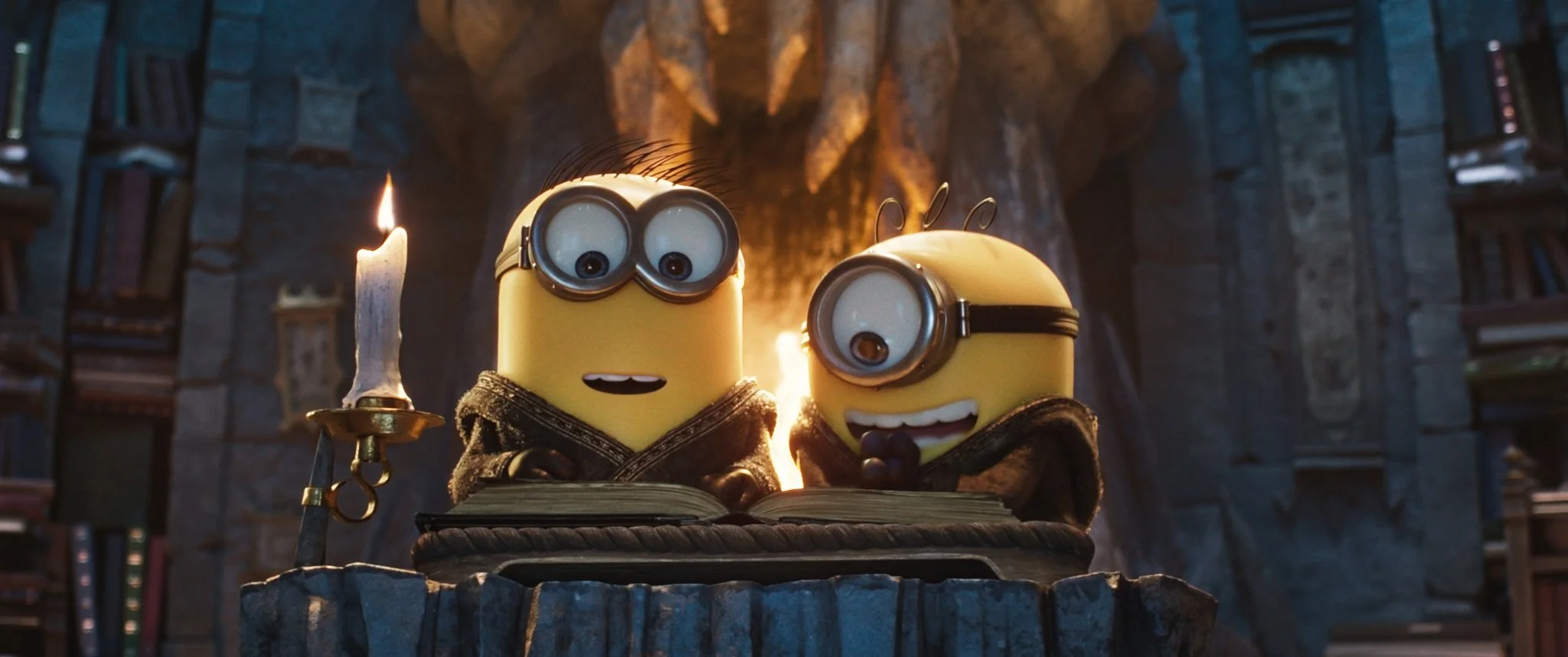
Image courtesy of Universal Studios
Intertextuality, as a construct, isn’t strictly relegated to adults. It may be easier for the trained mind to pick up on these things (Toy Story 5 includes a direct visual homage to Apocalypse Now), though there’s merit to the drip-feed of cinematic history via children’s entertainment. My introduction to Nosferatu was neither through Murnau, Herzog, nor Eggers; it was SpongeBob SquarePants. If anything, referencing Citizen Kane and The Maltese Falcon in a Minions movie is such an unorthodox way of introducing children to this era that I can’t help but be utterly charmed. In a way, Minions & Monsters shares an end goal with Criterion’s addition of K-Pop Demon Hunters to the collection: creating gateways for the next generation’s cinephiles.
Starring director Pierre Coffin as every single Minion except for Ed, a deaf Minion who signs in “Minionese,” Minions & Monsters follows James, Henry, and Ed as they stray from the beaten path in pursuit of Hollywood success. Set against the transition from silent to sound cinema, Minions & Monsters is a more overt period piece than the 60s and 70s backdrops of the previous films, functioning as a wholehearted romanticization of classical Hollywood cinema. There’s the obvious Minions-isms—banana and butt jokes aplenty—though I nearly kicked my feet with glee when the Minions went through the Modern Times gears along with Charlie Chaplin. Not once is there a hint of things going Boogie Nights, instead taking a hard turn into kaiju territory.
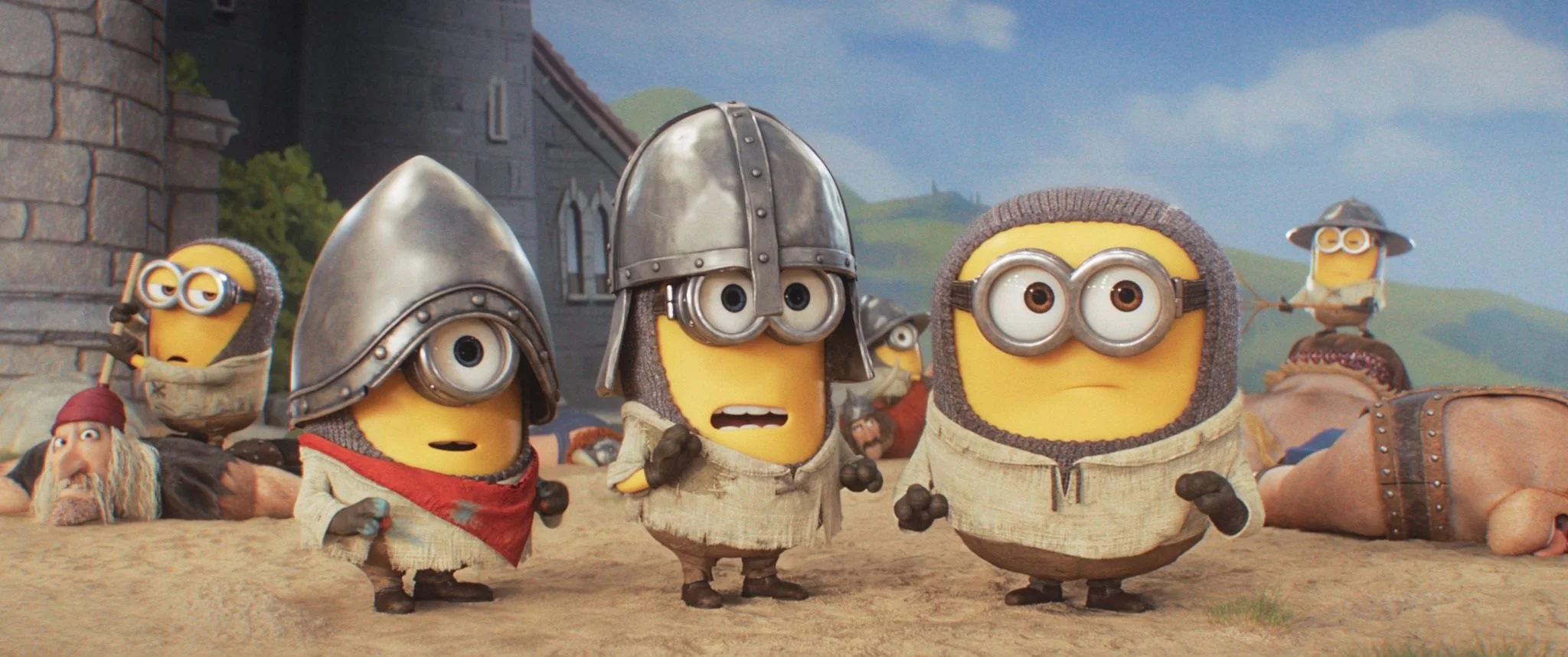
Image courtesy of Universal Studios
Established in Despicable Me, the Minions’ whole schtick is their obligation to serve the most evil master on Earth—whether that be Napoleon, Dracula, a cyclops, or a mummy. Call it cliché, though I assumed that Minions & Monsters would take a more biting approach and make Hollywood the Minions’ new evil overlord. The film hints at such things, with twin executives voiced by Jeff Bridges and a morally questionable director played by Christoph Waltz. Minions & Monsters idealistically kisses the hand that feeds, characterizing sound-era Hollywood as an absolute paradise. It’s silly to expect Network-level satire from a Minions movie, but the hard turn into Saturday-morning-cartoon monster shenanigans is lackluster compared to the first half’s unabashed sense of cinematic adoration.
No shade to Kevin, Bob, and Stuart, but I find the Minions & Monsters troupe far more endearing than their franchise predecessors. Part of the appeal is the Sammy Fabelman-esque passion behind James’ eye (just the one), and the other is the quasi-unspoken bond between the trio. Placing the search for a master on the back burner emphasizes the collective differences our focal Minions share, giving them motivations outside of the previous two films’ cookie-cutter objective. Splitting from their pack (led by a reservedly skeptical Minion named Dick), Minions & Monsters later becomes a three-hander between the gang as they enlist the services of Goomi (Trey Parker) to find their star kaiju for James’ directorial debut: Minions & Monsters.
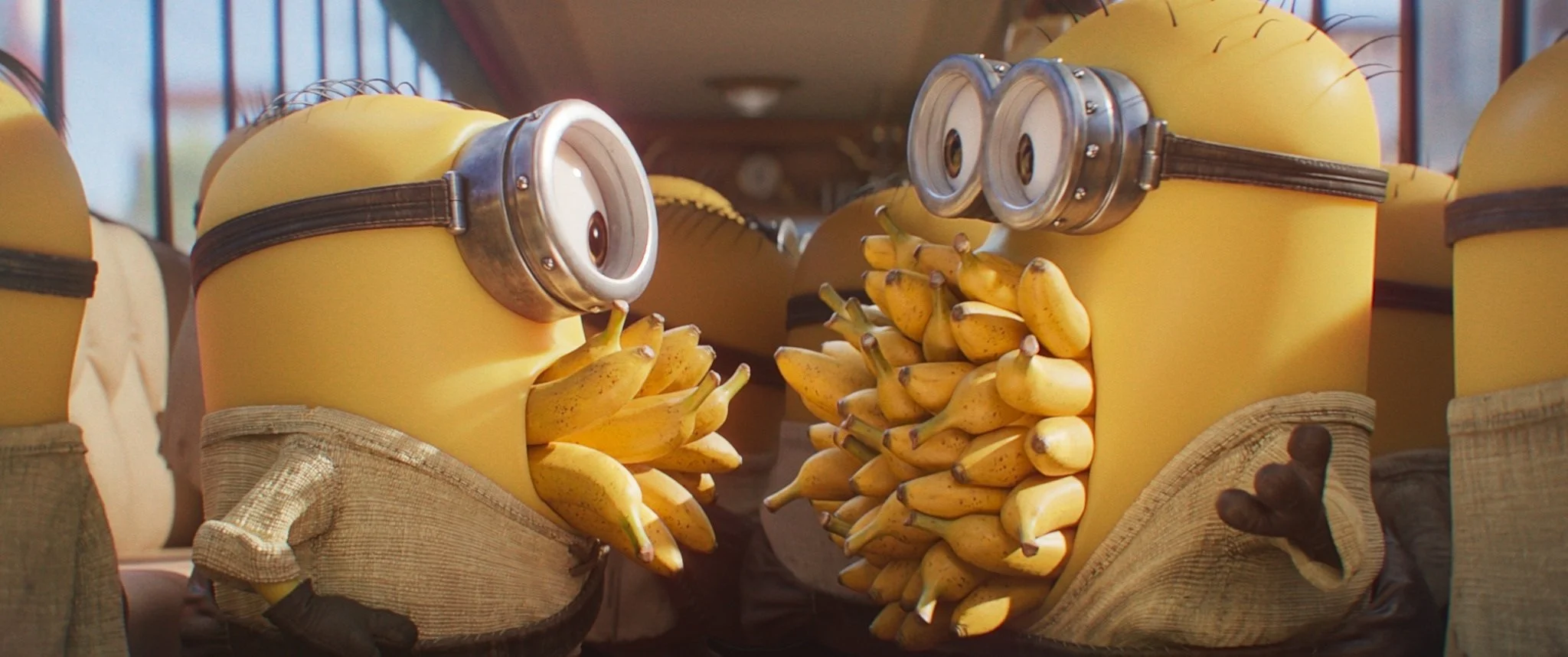
Image courtesy of Universal Studios
Things somewhat fall apart in Minions & Monsters’ second half, as the abrupt shift to the monsters being the film’s antagonists, while fun, is also an unfortunate case of squandered potential. Fun as Bobby Moynihan and Phil LaMarr (two of our finest working voice actors) are as a duo of weird sea creature monsters, the latter half’s switch-up into more generic Minions-y territory is still disappointing. B-plots of Dick’s gang of Minions joining the suffragettes alongside a guy who may or may not be a robot alien are certainly very funny, but Minions & Monsters fails in meaningfully coalescing these hanging threads. It goes down nicely with a bag of Sour Patch Kids and a Sprite, though that’s all there really is.
As far as Illumination movies go (the bar is unbelievably low), Minions & Monsters having actual themes and messages puts it leagues above the rest. There’s enough fun to be had to circumvent being a total time-waster; just don’t go expecting any turning gears under the hood. It’s thankfully less brainless and far more inspired than Illumination’s usual output (I’m looking at you, The Super Mario Galaxy Movie), though it pales in comparison to other, more inventive contemporaries like Hoppers, K-Pop Demon Hunters, or The Wild Robot. Sure, Minions & Monsters is narratively clunky with a formulaic third act; I can’t bring myself to dislike a movie where Citizen Kane’s opening scene is parodied by a Minion saying “poop” instead of “rosebud.”